Changing the Center of Gravity: Transforming Classical Studies Through Cyberinfrastructure
2009
Volume 3 Number 1
Abstract
The Web, though full of historical information, lacks a means of organizing
that information, searching on it or visualizing it. The Historical Event
Markup and Linking Project (Heml) was begun six years ago to explore how
disparate historical materials on the Internet can be navigated and
visualized, and for the past four years has used an XML data format defined
in W3C Schemas. This format aims for conforming data that can be quickly
parsed but provide a variety of facets on which to search for historical
materials. While the project's graphical visualizations are in some
respects successful, they have revealed some deficiencies in the underlying
data format: it ought to provide for nested events, it ought to represent
relations of causality between events and it ought to express the varieties
of scholarly opinion about the attributes of events. By encoding the Heml
data in the Resource Description Framework (RDF) it is possible to
undertake these improvements. Moreover, an RDF-encoded Heml process
provides easier access to CIDOC-CRM data into Heml events. Finally, a
historical RDF language would simplify the discovery of references to
historical events in digitized texts, thereby automating a growing network
of historical information on the Web.
Introduction
Beginning his work which was to be the first called a “history”, the
Greek author Herodotus describes his task in simple terms: “to preserve the memory of the
past by putting on record the astonishing achievements both of
our own and of other peoples”
(line 1.0). Within the first few chapters, though, it becomes clear that, to
Herodotus, this entails something more multivalent than mere story-telling.
His very next sentence buttresses the narrative with references to its
various, even conflicting, sources 1.1; not much
later, he corroborates his stories by referring to physical artifacts and
providing careful genealogies 1.7, 1.14; and throughout he attempts to place the
notable events of the past within the available chronological outlines
(e.g, 16.1). From its origins, then, history has
been conducted across a framework of argumentation, evidence, chronology
and prosopography.
This intellectual approach, begun by Herodotus and his rough contemporaries
around the world, has proved a durable and useful way of thinking.
Moreover, as the global Internet expands, and the common software
technologies of the World Wide Web provide us with unprecedented means of
communication, humanity has greater access to more historical statements
and more of the raw materials of history than ever before. Indeed, it might
be said that today's Web has the makings of an historian's fantasy: it
provides worthy encyclopedia entries on a vast array of topics; its textual
editions are rapidly improving in quality and amassing in quantity; and it
offers historical source material ranging from argumentation in on-line
editions of the best journals to the first-hand accounts appearing in blog
entries. Scholarly historical projects published uniquely on the Web are
common, supported by academic centres whose purpose is to communicate
history effectively in new media, and who are also addressing the general
problems of adopting best standards of scholarship to the Web in projects
such as
Zotero. Behind the scene,
data formats such as the CIDOC-CRM aim to make it possible to interchange
and reconcile vast cultural archives.
However what today's Web offers in historical content, it lacks in
organization. The multivalent nature of historical thought that we noted in
one of its earliest practitioners eludes the keyword-indexed approach to
the Web today on offer through Google and other search engines. Though we
can summon up an exhaustive list of Web resources that contain the
words
“Gallipoli” and “sources”, today's Web cannot effectively respond
to a basic historical question such as, “which sources attest the
Gallipoli Campaign of World War I?” much less a more advanced one
such as, “what evidence is there for major architectural projects
undertaken in the U.K. during the period of the Boer War, and does
anyone think that these projects are influenced by the conflict?”
If it were possible to conduct such a query, of course the result would not
itself qualify as “history” any more than the results of a Google
search constitute knowledge. However, the results of such a hypothetical
search would offer a considerable aid to historical research and thinking,
just as the indices, maps and, occasionally, tables that appear at the end
of most monographs allow the reader rapidly to access matters of interest.
Applying this analogy, what is needed in the Web is “universal
back-matter”, a Web-wide equivalent to the traditional print
monograph's helpful conventions.
[1]
Herodotus and his successors have given us a template for such a project.
Minimally, it will need to express associations between words describing
the event through chronology, geography and prosopography. It will need to
provide references to diverse sources and evidence, and it will need to
traverse, as much as possible, the boundaries of local language and even
local time-keeping techniques.
[2] Indeed, over fifteen years ago, the prescient Historian's
Workstation Project employed the same basic types of data [
Thaller
1991]; however, the Internet has added the challenge
of working with a more heterogeneous set of data sources and today's
possibilities for the visualization of historical data go far beyond the
Workstation's.
[3]
The Historical Event Markup and Linking Project (Heml) has pursued the
vision of a system such as this since 2001, when it began to explore the
markup and transformation of historical materials on the Internet using XML
tools. All schemas and code developed by this project are available at its
website,
http://www.heml.org/ and
complete revision history is provided in an SVN repository. This paper
explains Heml's next step toward the goal of an historical Web. It outlines
the data format used by the project, shows the shortcomings of our previous
XML-based approach to historical markup and describes the potential of an
historical markup scheme based around the W3C's Resource Description
Framework, or
RDF,
to interchange historical concepts widely and to express them in a more
nuanced manner.
It is a pleasure to be able to offer this paper in the collection of works
celebrating the achievements of Ross Scaife. Like so many efforts in
computing and the Classics, this one has been nurtured by Ross' kind
support and encouragement. Furthermore, I have always hoped that Heml would
attain the level of openness and helpfulness that are the hallmarks of
Ross' work and of his character.
The Heml Data Model
The goal of a searchable network of historical information can only be
reached through a clear separation between the model of the data being
searched, the parameters of the search and the resulting visualization of
the data. Since the project intends that these visualizations be generated
dynamically in response to users' queries, the data model must be specific
enough that the visualization can generated quickly; likewise, since the
results of users' queries could result in no events, one event, or
thousands of events, and the range of values represented in these encoded
events could be quite wide, the visualization processes must be written so
as to generate useful views without regard for the number of events
visualized or how close or far they are in time and space. For this reason,
the Heml project has attempted to steer a middle path between pragmatism
and markup idealism, especially regarding chronology. Thus, its data
schema, on one hand, is not a complete abstraction of any way in which a
person might think of the past, since this would make the task of
visualization too daunting. In particular, its schema requires
machine-readable data for all defined geographical and chronological data.
(As shown below, this does not preclude the schema representing
uncertainty.) On the other hand, the schema is not merely an API for the
various visualizations offered by Heml; it is abstract enough that many
other visualizations and uses could be discovered.
At its inception, the Heml server software transformed XML documents
one-by-one [
Robertson 2002]; in versions 0.4 to 0.7.2 the
project adopted a distributed XML model, backed up by the
eXist XML database [
Robertson 2004], an approach that worked well in a
collaboration with Tom Costa's project,
Geography of Slavery in
Virginia, where a Heml Web application backed by eXist
transforms events pertaining to slaves into hundreds of dynamically
generated maps and timelines. In either case, the project's data model has
remained the same for the past four years, and the following describes the
model labelled 2003-09-17.
The Heml data format contains a collection of modelled events, each tagged
with <heml:Event>. At their most simple, events bind an event label
with a machine-readable span of time and a reference to evidence, which
could be as simple as a single URN. Optionally, a <heml:Event> may
also comprise any number of keywords, and a single location, which in turn
is defined as a labelled pair of latitude and longitude coordinates.
<heml:Person> elements may be added to events in order to
represent those people who were in some way involved in the event. If the
nature of this participation is known, the <heml:Person> element may
be bound to a <heml:Role> element within the context of the event.
Persons, roles, locations, and keywords are assigned mandatory URIs so that
they may be referred to in multiple events. Finally, one or more
<heml:Evidence> elements must be attributed to each event, and
within these there is a means by which different editions and linguistic
representations of the same text may be grouped together for the
researcher's benefit.
Chronology
The most complex part of Heml's data model is the
<heml:Chronology>
element. Its model is intended to express uncertainty and ranges of time
without requiring the visualization engine to have access to all data.
[4] In Heml markup, chronological concepts are always built using one
of the following four elements:
<heml:DateTime>,
<heml:Date>,
<heml:Year> or
<IntCalDate>. The first three of these
encapsulate data encoded in the corresponding XML Schemas format; the last
permits the user to encode with a non-Gregorian calendar. When used alone,
these elements are meant to indicating a corresponding span of time: for
instance the
<heml:Year>-31<heml:Year> indicates
an event that began on the first second of the first day of 31 BC and ended
on the last second of its last day. To express a more expanded range of
time, the
<heml:DateRange> element is used, and within it mandatory
<heml:StartingDate> and
<heml:EndingDate> elements. This
construct is parsed as indicating a span of time beginning at the beginning
of the first element and ending at the ending of the last one. To express
uncertainty, the
<heml:BoundedDate> element is used. It comprises a
<heml:TerminusPostQuem> and a
<heml:TerminusAnteQuem>
element; these express the earliest possible and latest possible time
respectively of a span of uncertain time. Use alone,
<heml:BoundedDate> makes no claim about the duration of the
encoded event. However, it is permitted to use a
<heml:BoundedDate>
within the
<heml:StartingDate> or
<heml:EndingDate> of a
<heml:DateRange>.
<heml:Chronology>
   <heml:DateRange>
      <heml:StartingDate>
         <heml:DateTime>1995-05-21T21:03Z</hemlDateTime>
      </heml:StartingDate>
      <heml:EndingDate>
         <heml:BoundedDate>
            <heml:TerminusPostQuem>
               <heml:Date>2005-03-21</heml:Date>
            </heml:TerminusPostQuem>
            <heml:TerminusAnteQuem>
               <heml:Date>2005-03-21</heml:Date>
            </heml:TerminusAnteQuem>
         </heml:BoundedDate>
      </heml:EndingDate>
   </heml:DateRange>
</heml:Chronology>
Example 1.
Example of Chronological Information Expressed in Heml's
2003-09-17 Schema
Thus the XML in
Example 1
encodes as an event beginning at exactly 21:03 UTC on May the twenty-first
1995 and ending at some time on March the twenty-first 2005.
Similar Schemas
There are other schemas from other fields that encode representations of
labelled spans of time and place.
Dublin Core Metadata standard includes date and location tags
that, in certain uses, encode certain kinds of historical events, but these
naturally revolve around the documents themselves, such as publication
information; they cannot, for instance, encode the battle described
therein. Similarly, the P5 edition of the TEI includes a welcomed set of
biographical and prosopographical tags, including one for
events. However, at present, all such P5
<event> elements must
appear within a
<person> or
<place> element, expressing that
the event information serves to further our information about a given
person or place: events that pertain to neither at present cannot be
encoded.
Finally, the
CIDOC-CRM
encodes descriptions of cultural artifacts in terms of the events they
undergo — their creation, change of custody, and so forth. Though not the
primary focus of this schema, historical events are quite broadly modelled
in this schema. Indeed, as is shown below, the unmodified CIDOC-CRM model
is too liberal for the Heml Project's purposes of generating historical
visualizations, especially with reference to what entities and datatypes it
accepts as chronological predicates. Nevertheless, it is likely that most
of the goals of the Heml project can be fulfilled through RDFS subclassing
of the the CIDOC-CRM model, ensuring more carefully data-typed
chronological classes. In any case, the discussion and examples below would
apply as well to such a constrained CIDOC-CRM model or to any future schema
with similar properties. Indeed, the purpose of the Heml project is
decidedly not to promote a particular schema; instead, its schema is
intended as a tool which enables us to explore the process of combining all
material encoded in all these well-entrenched and widely-adopted schemas so
as to increase the pool of inter-related historical data on the Internet.
Technologically, there is little challenge in transferring data from one of
these representations to Heml. XML representations can be exchanged through
XSLT. In RDF, the SPARQL
CONSTRUCT query form produces transformations from one graph to
another. For example, [
Robertson
2006] shows how useful a
simple Heml and Dublin Core mash-up conducted in XSLT could be.
Visualizations
Heml data is encoded in order that resources pertaining to a certain
historical event may be found in response to a user's query. The query
might be expressed with regard to any one of the facets of historical
expression encoded by the schema above, or on some combination of these.
The software discovers the corresponding materials, then generates a
visualization of these data according to the user's wishes. Visualizations
range from simple chronological text lists in HTML to complex animated
maps. Of course, since the data has been prepared without reference to any
given visualization, not all visualizations are informative representations
of all query results. For instance, an animated map would not be helpful if
the set of events in the query response all had the same location or did
not have locations encoded at all.
In the most recently-published version of Heml's server software (v. 0.7.2),
visualizations are generated through a Java Web application based on the
Cocoon Web service
engine. Instructions for building and running this software locally are
available at
http://www.heml.org.
Using this approach on locally-stored data takes full advantage of Cocoon's
ability to cache server-side processes. However, it is also possible to use
the server at
http://www.heml.org
to transform any conforming document published on the Web without building
or installing software. Instructions are provided online.
As described above, all the visualization tools developed by the project
operate fully automatically: they provide sensible chronological and
geographical boundaries based only on the conforming data on their input
and layout the appropriate text without clipping or abbreviation,
regardless of the number of events being presented.
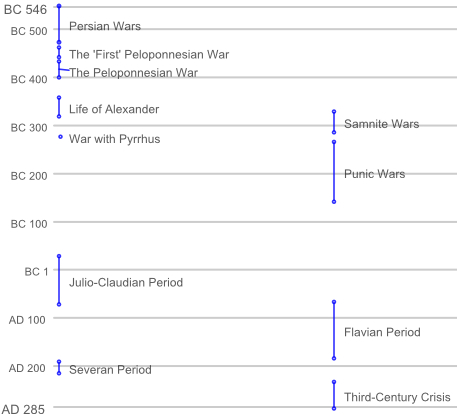
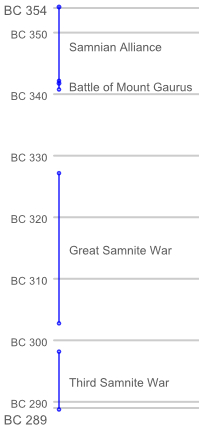
The graphical timeline view, of which
Figure 2
and
Figure 3 are examples, lays out event
labels at a vertical distance from each other corresponding to their
separation in time. It indicates spans of time through vertical coloured
lines. This view was designed to be legible and to require as little user
interaction as possible, emulating a graphical timeline in print. In fact,
the rendering software iterates through layout scenarios in order to find
one that is appropriately compact but whose text is still possible to read.
It ensures that the entire text labelling an event is always visible to the
user, and scrolling is not necessary to read the event label. The software
also selects an appropriate range of dates or times for the events; these
can range from a seconds to millennia.
[5] Rendered in SVG, this view's event labels are linked to popups that
lead the reader to the resources pertaining to the event.
This approach to timeline-generation differs from other online graphical
timeline-drawing, perhaps best represented by the the Simile
timeline widget. At
present, the Simile timeline is not auto-ranging, and does not attempt to
optimize layout. Rather, its documentation encourages users to identify
so-called “hot zones”, temporal ranges comprising unusually large
numbers of events so that the drawing routine can alter the scale in these
ranges, thereby producing a more legible layout. The goals of the Heml
project, requiring a fully automated rendering, do not make such
hand-tweaking possible. However, Simile timeline's excellent use of
client-side rendering and DHTML are certainly preferable to the Heml
timeline approach. We hope that by modify the open-source code for Simile
timelines we can adopt that project more closely to our needs, perhaps by
identifying “hot zones” computationally.
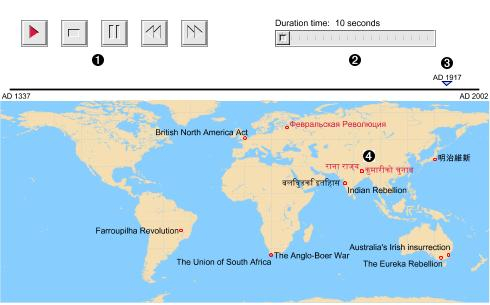
Another event-visualization system pioneered by the Heml Project is the
animated map illustrated in
Figure 1.
(1) is a set of user-operated controls familiar from
audio-visual apparatus. With these, the user can stop, play pause, rewind
and speed up the animation. Item
(2) is a slider
control that sets the length of the animation in seconds. Item
(3) is a moving marker that runs along the line above
the animation from left to right, thereby indicating the moment in time
currently represented on the map. Above the small triangle a constantly
updating text appears recording the current animation time. The event
labels at
(4) appear in red text as long as the
animation is representing a date during which the labelled event is encoded
as having taken place. In order that the user be able to read them, event
labels do not necessarily disappear as soon as the corresponding event ends
in the animated time; rather they remain on the screen in black text until
the text has appeared for at least two seconds. The system designates an
appropriate chronological scale to the process, as well as the geographical
range of the map.
Areas For Improvement
Although these visualizations have fulfilled some of our goals, they have
also pointed out some deficiencies in the underlying data model.
Figure 1, for example, presents an apparent
mishmash of events. Perhaps the user undertook a too-broad query, but when
dealing with any large dataset this sort of result is common because the
XML schema puts all events, no matter how trivial, on the same footing. It
has therefore been suggested that events should be ranked, or should nest,
with large scale events such as “The Persian Wars” expressed as
parents of their composite events, like “The Battle of Thermopylae.”
In response to publications and presentations of the Heml/XML model, others
have expressed a desire for more complex historical relations between
events to be encoded. Should not Heml express something as simple as
causality, such as the fact that Ephialtes' treachery led to the defeat of
the Three Hundred? Finally, it has been noted that with Heml/XML markup it
is not possible to encode the variations in opinions regarding historical
events. When scholars debate the date of the arrival of the Greek-speaking
ancestors of the Mycenaeans, what date should be encoded for this
event?
Some of these issues have been tackled recently by [
Nakahira 2007], but in the Heml XML Schema they were
intentionally left unaddressed for both theoretical and practical reasons.
First, it has been this project's experience that resolving such relations
with a language such as
XQuery or XSLT was difficult and computationally expensive.
Secondly, since the XML Schema expresses matters pertaining to an event by
nested elements, it was unclear where a statement linking two elements
should appear. Pertaining no more to one element than the other, ideally it
should stand outside the
<heml:Event> elements, but this raised the
prospect of always new schemas required to provide metadata for previous
schemas. Finally, a XML schema through which scholarly debate could be
encoded for any facet of an event seemed likely to be unmanageably
complex.
RDF and Heml
Our work of the past year shows that these problems can be addressed by using
the W3C's Resource Description Framework (RDF) as our means of encoding
Heml events and related information.
[6] As a collection of statements expressed through URIs, RDF is well
suited to define metadata that expresses associations between events.
Because these statements are unordered, these associations can be asserted
in any source of data, anywhere. Moreover, RDF defines a method known as
“reification” whereby a statement comprising Subject Verb and
Object can itself play the role of subject or object in another,
encompassing statement.
Example 2
illustrates the process with an example from Greek prehistory. The first
line makes a simple statement, without attribution, that the ancestors of
the Mycenaeans arrived in the Greek mainland in 1600 BC. The second line
indicates the reification of that statement with parentheses, and
attributes this chronology to Drewes with the
hemlRDF:asserts
predicate. The third line refers to the same
<#Arrival_of_the_Greeks> subject, but it
shows that Renfrew assigns that subject a much earlier date.
Statement : <#Arrival_of_the_Greeks> <hemlRDF:simpleDate> -1600
Reified Statement A: <#Drewes> <hemlRDF:asserts>
   (<#Arrival_of_the_Greeks> <hemlRDF:simpleDate> -1600)
Reified Statement B: <#Renfrew> <hemlRDF:asserts>
   (<#Arrival_of_the_Greeks> <hemlRDF:simpleDate> -6000)
Example 2.
RDF Reification as A Means of Encoding Scholarly Debate
Regarding an Event
The URI corresponding to a scholar then becomes a part of
the query, and it is possible to encode, and later summon up, an entire
body of knowledge with reference to the scholar asserting it. For example,
the chronology of fifth-century Athens could be encoded with reference to
the arguments of Badian or those of Pritchett. This technique becomes all
the more important when even more tendentious predicates are applied, such
as causation.
[7]
Data-Entry for HemlRDF
Despite these possibilities, we were concerned that the increased
representational complexity of RDF would make it difficult for
students and other users to encode their data. In fact, in the summer
of 2007 we had excellent experience using the
Semantic MediaWiki extension to MediaWiki as a HemlRDF
editor. With this environment, motivated students as young as ten
years old produced dozens of fully-compliant RDF-encoded events with
an hour's work. The resulting RDF is not identical to the HemlRDF
parsed by the Web application because certain simplifications were
considered helpful to the user.
[8] However, a simple SPARQL
query, available in the
/sparql/wiki/ directory of the
project SVN repository, transforms the data to HemlRDF. With some
work, or as Semantic MediaWiki improves, it might be possible for it
to generate HemlRDF directly, thereby allowing students to see
automatically updated visualizations as soon as they save encoded
events and related articles. A
tar.gz SQL dump of our
project's wiki, which includes the semantic metadata, is regularly
generated and available at
http://heml.mta.ca/releases/Wiki.
RDF-Based Nested Events
While building a dataset of ancient history in the Wiki, we experimented
with one of the improvements suggested above, and encoded certain
events as “comprising” others with a
hemlRDF:comprisesEvent predicate. In
Example 3 the nested representation
indicates that the
<heml:Event> with the URI
wiki:Samnite_Wars is described as comprising
wiki:Battle_of_Mount_Gaurus, etc.
<smw:Thing rdf:about="wiki:Samnite_Wars">
<rdf:type rdf:resource="http://www.heml.org/rdf/2003-09-17/heml/Event"/>
<rdfs:label>Samnite Wars</rdfs:label>
<smw:hasArticle rdf:resource="&wikiurl;Samnite_Wars"/>
<rdfs:isDefinedBy rdf:resource="&wikiurl;Special:ExportRDF/Samnite_Wars"/>
<hemlRDF:comprisesEvent rdf:resource="wiki:Samnian_Alliance"/>
<hemlRDF:comprisesEvent rdf:resource="wiki:Battle_of_Mount_Gaurus"/>
<hemlRDF:comprisesEvent rdf:resource="wiki:Great_Samnite_War"/>
<hemlRDF:comprisesEvent rdf:resource="wiki:Third_Samnite_War"/>
</smw:Thing>
Example 3.
RDF Expressing A “Parent” Event By Means of a Series
of “Child” Events
These “parent” events are ascribed chronologies,
participants, and all other properties wholly in terms of their
children elements. For instance, the earliest date on which any child
event begins is treated as the earliest date of the parent; and the
latest date on which any child ends is treated as the latest date of
the parent. This process is recursive: there can be parent events that
are themselves children of others. Although we performed this
reasoning by parsing the RDF model in memory, it is hoped that the
same effect could be made with Web Ontology (OWL) statements.
Figure 2 is a timeline generated
entirely from top-level parent events encoded in the wiki. This
provides the user with a more comprehensible view of the data.
Furthermore, in some future system that provides an appropriate control
interface, the user could “open” these composite events and
explore more deeply the nested layers therein.
Figure 3 is an expanded view of the “Samnite Wars”
event drawn in the top right corner of
Figure
2 and whose encoding appeared in
Example 3.
HemlRDF and the CIDOC-CRM
One of the most exciting possibilities we anticipated in the historical
RDF realm was visualizing CIDOC-CRM data through Heml tools. Because
the CIDOC-CRM defines objects in terms of the events they undergo,
CIDOC-CRM potentially is a treasure trove of well-encoded events
related to material culture. Robert Kummer of the Perseus Project
kindly provided us with the Perseus art and archaeology database
encoded in RDF/XML.
Example 4 is a
small portion of this, in which the item known as 'BCMA 1919.58.81' is
declared to have been produced no earlier than 480 BC.
<crm:E12.Production
							rdf:about="http://perseus.tufts.edu/Production_of_BCMA_1919.58.81">
							<dc:title>Production of BCMA 1919.58.81</dc:title>
							<crm:P4F.has_time-span> <crm:E52.Time-Span>
							<crm:P82F.at_some_time_within> <crm:E61.Time_Primitive
							rdf:about="http://perseus.tufts.edu/date/-480"/> <hemlRDF:SimpleTime
								rdf:dataype="http://www.w3.org/2001/XMLSchema#gYear">-480</hemlRDF:SimpleTime>
							</crm:P82F.at_some_time_within> <crm:P2F.has_type
							rdf:resource="http://perseus.tufts.edu/starts_with"/>
							<crm:P3F.has_note>ca.</crm:P3F.has_note>
							</crm:E52.Time-Span> </crm:P4F.has_time-span>
Example 4.
Perseus CIDOC-CRM Data With Added Elements
Note that the non-heml date elements encode time using a URI. Since the
purpose of CIDOC-CRM is to identify and coordinate the resources, this
is a wholly appropriate use. However, any RDF application that is
acting on this as a date, Heml included, will need to access it as a
literal, preferably with appropriate datatyping. We used Perl regex to
insert a sister element to the Time_Primitive. Since this
might not always be easy to do, developers of CIDOC-CRM data who wish
to explore the data in systems like Heml would be well advised also to
generate literals for dates and locations that employ standard
datatypes such as the xsd:gYear illustrated above.
A SPARQL query — available in our SVN server — transforms the rest of
the CIDOC-CRM into HemlRDF, which then can be processed by the
visualization tools and viewed alongside events encoded in other
schemas.
Heml's Future
From its inception, the XML-based Heml has used the Apache Cocoon Web
service framework to store data, to set controller values and to
transform data into the views shown above. In the experiments
regarding the potential of RDF illustrated above, we grafted the
Jena RDF parser into
this system, using it as a means of down-converting Heml RDF data into
the XML format around which the Heml Web service framework grew.
[9] The resulting system and its critical components are
illustrated in
Figure 4. This is a
heavy-weight, server-side toolkit out of keeping with modern trends in
Web software. Although the project strives to make its software freely
available through GPL licensing, the general effectiveness of Heml has
been reduced because of the project's server-side orientation.
Since the advanced features of Heml described above will require RDF
technologies, our project proposes next to remove the XML format
entirely from its processing pipeline. Ideally, we wish to follow the
general trends of Web computing and pass all processing over to the
client; it will occasionally call its server for additional RDF data.
The proposed architecture is illustrated in
Figure 5.
Although its data store and communication are modelled in
RDF, this system still can consume any (non-RDF) XML that is of
historical interest, such as the biographical P5 TEI tags. An
appropriate XSLT stylesheet converts such materials to XML-encoded
RDF. Finally, since it appears that declarative animation in the SVG
format is being abandoned, Heml will explore other vector graphics
formats and likely use the popular cross-platform Flex3 platform from
Adobe. We are also adopting of third-party visualization tools that
have arisen in recently, such as
Simile Timeline
and the
OpenLayers
mapping suite.
The combination of the SPARQL query language and RDF is reasonably
powerful, but it lacks some temporal capabilities which we have had to
add through extension functions written for the Joseki SPARQL server
engine. For instance, while the SPARQL specification permits the query
to request a response that is ordered by one or more datatyped values,
the only temporal datatype that it will order in this way is
xsd:DateTime, that is, dates specified to the
second; the specification does not indicate how to order dates
specified to the year or day, much less to compare between these
datatypes. Our extension function uses
SPARQL
Update to apply to the in-memory RDF graph a starting and
ending
xsd:DateTime corresponding to the beginning and
ending of the chronological ranges indicated by these other datatypes.
Further improvements in chronological analysis could be made through
the use of the CIDOC-CRM's predicates based on Allen temporal logic
[
Allen 1983] and further use of SPARQL/Update.
[10]
Projected Work
Finally, we plan to undertake the automated discovery of references
to historical events in unexplored digitized texts. We can expect
these texts to be created in ever-increasing numbers, either by
large-scale endeavours like the Open Archive Initiative, by the
Google Books project, or through local efforts such as the one
described in [
Carrera 2005], which become more
practical as improved Optical Character Recognition software is
developed in large-scale endeavours. The method described below
was inspired by Greg Crane, whose published thoughts on the topic
began in [
Crane 2006].
[
Smith 2002] and the work of the
TimeML group show how
effectively extracted named entities and natural language
processing techniques can be used to identify events. While these
natural language processing approaches discover hitherto
unidentified events — typically from newspaper articles — we
intend to apply some of the same machine learning techniques to
discover references to
canonical events, already
encoded and stored in HemlRDF. (Such canonical events would be
extracted from standard reference works.) This system thus could
train linear classifiers with the persons and places associated
with an event, as well as other additional features encoded in
HemlRDF. For instance, the appearance of a reference to a primary
source already associated with an event would be a strong
indication that that event is being discussed. While in some
disciplines it would be a considerable task to accurately
identify such references with the one on record in the RDF
database, Smith's work on
Canonical Text Services promises to simplify the
task. The event's label will also serve as a useful feature,
especially if it were parsed with the
Wordnet database, which itself is now available in a
RDF/OWL format.
Conclusion
RDF technologies are providing Heml with several new avenues for
research and a plan for reinventing its means of delivering historical
visualizations. If it is true that “...people have achieved
their humanity in part by attaining a fuller comprehension
of their own place in time and space”
[
Clark 1992, xi], we might hope that the historical potential of the Web will
some day give us an unprecedented understanding of our place in time
and a greater sense of our own humanity.
Acknowledgements
The RDF data in this paper was produced through a Curricular Innovation
Grant at Mount Allison University. The National Research Council of
Canada funded the development of CIDOC-CRM and Heml XML/RDF bridging
code through its Industrial Research Assistance Program.
Notes
[1]
It might be observed that since Wikipedia has made
great strides in organizing historical information on the Web,
the (seemingly inevitable) continued growth of this resource will
fulfil this goal. However, as an encyclopedia, Wikipedia does not
aim to be exhaustive. Its notability guidelines rightly forbid a great deal of
material to which historians might wish to have ready access.
Moreover even those Wikipedia article which do explain historical
events cannot comprise exhaustive lists of references, secondary
sources and other evidence. As described later in this paper, the
Heml Project has has good experiences using the Semantic MediaWiki extension to its Mediawiki software as a means of RDF data entry.
[2]
[Carrera 2002] defines the set of “cultural
semantics” as those concept which requires the localization of
language and terminology. [Drucker and Noviskie 2004] make it clear
that the problem of time-keeping and calendars, personal or
collective, should be added to the list of “cultural semantics.”
[3]
The Electronic Cultural Atlas
Initiative has developed a coordinated network of
databases, whose limited access helps to ensure the authority and
quality of the aggregated data. A windows application is
available for entering conforming data, and the excellent TimeMap software
produces rich historical GIS visualizations in the client's
browser.
[4]
This precludes the use of the exhaustive representation of temporal
expressions in natural language that the TimeML markup language
provides.
[5]
See the timeline views of the columbia_accident and
greek_prehistory at http://www.heml.org for
examples of very brief and very long events rendered in this
view.
[6]
Tim Berners-Lee's Primer on RDF is a good introduction for those new to
the subject.
[7]
Two widely recommended means of RDF reification that appear to be
sufficient for Heml are the appropriate use of rdf:ID and predicate subclassing. For our purposes, as for most
humanists', the choice will depend on support for these in query
languages and their implementation.
[8] In particular, since
Semantic Media Wiki treats each node is an article, nodes which
are usually treated as “blank nodes” in RDF are difficult to
deal with in this Wiki extension.
[9]
While appropriate XML can be converted to RDF with an XSLT
transformation (and the Heml Project has therefore provided
such a transformation for many years), the opposite is not
true: there is no XML-based tool that can reliably convert
RDF (in its standard XML format) into a sister, non-RDF, XML
format.
[10]
It is also likely that the temporal built-in fuctions for SWRL provided with the
Protégé ontology editor could be modified for
use as extension functions in SPARQL queries.
Works Cited
Allen 1983
Allen, J.
“Maintaining knowledge about temporal
intervals”. Communications of the ACM.
New York, NY, 1983 26.11.
Carrera 2002
Carrera, F.
“Challenges for a Semantic Web”. Proceedings of the International Workshop on the
Semantic Web 2002. Hawaii, May 7,
2002. pp. 16-22.
Carrera 2005
Carrera, F.
“Making history: an emergent system for the systematic
accrual of transcriptions of historic manuscripts”
Document Analysis and Recognition, 2005. Proceedings.
Eighth International Conference on 1 29 Aug.–1 Sept.
2005 543–547.
Clark 1992
Clark, G.
Space, Time and Man: A Prehistorian's View.
New York, 1992.
Crane 2006
Crane, G.
“What Do You Do with A Million Books?”
D-Lib Magazine. 12.3 March
2006.
Drucker and Noviskie 2004
Drucker, J. and Noviskie, B.
“Speculative Computing: Aesthetic Provocations in
Humanities Computing”. A Companion to
Digital Humanities. Susan Schreibman,
Ray Siemens and John Unsworth ed.
New York, 2004.
Nakahira 2007
Nakahira, K. et al. “The Use of XML to
Express a Historical Knowledge Base”. WWW
2007. Banff, Alberta,
2007.
Robertson
2006
Robertson, B.
“Visualizing An Historical Semantic Web with
Heml”. Proceedings of the 2006 W3C
Conference. May 23-26, 2006
Edinburgh, p. 99.
Robertson 2002
Robertson, B.
“An Overview of the Historical Event Markup and Linking
Project”. Dalla Fonte all Rete: Il
linguaggio XML e la codifica dei documenti storic, archeologici e
archivistici. Centro di Ricerche Informatiche per i
Beni Culturali,
Pisa. 12.1, 2002.
Robertson 2004
Robertson, B.
“Improving Ancient History Online with Heml”.
C. Blackwell, R. Scaife ed. Classics@. 2, 2004.
Smith 2002
Smith, D.
“Detecting Events with Date and Place Information in
Unstructured Text”. International
Conference on Digital Libraries. Proceedings of the 2nd ACM/IEEE-CS
Joint conference on Digital Libraries. 10, 2002.
191-196.
Thaller
1991
Thaller, M.
“The Historical Workstation Project”
Computers and the Humanities. 25, 149-162,
1991.