



DHQ: Digital Humanities Quarterly
2009
Volume 3 Number 3
Volume 3 Number 3
“May the Text Rise up to Meet You”: New Ways of Reading Old Manuscripts
Abstract
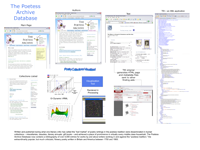
This poster demonstrates the suite of programs I created for the Society of Early English and Norse Electronic Texts (SEENET) to facilitate the display of its TEI-compliant documentary and critical editions of medieval texts.
Poster Abstract
Interface design was the uppermost concern when I set out to create a suite of
programs for the Society of Early English and Norse Electronic Texts (SEENET) to
facilitate the display of its TEI-compliant documentary and critical editions of
medieval texts. From its inception, my project has been shaped by the tremendous
potential of electronic textuality to redefine our experience of what it means to
possess and read a text. This poster demonstrates these programs and surveys the
principles that have given rise to their creation.
The SEENET interface project has been carried out as an iterative process moving
between (1) identifying the broad parameters of questions that readers might be
tempted to ask of a text and (2) shaping an electronic mise en
page that will engage a reader’s inquisitive eye, promoting curiosity
and thus the development of new insight and knowledge. The process of developing such
an interface has led to the articulation of a set of axioms that have guided my work:
- Seek tight coordination in the display of text and facsimile image
- Incorporate visual cueing to guide/reinforce reader attention
- Provide unobtrusive, but handy, analytical tools
- Promote ease of navigation – build in linkages that are likely to answer and/or provoke a reader’s curiosity
- Work in one visual space for text and images – no windows or frames, no scrolling when possible
- Supply information at likely points of need – avoid overload, expose what the text “knows” selectively
- Keep decoration to a minimum: no chrome, don’t frame the view, don’t let the tools distract or overwhelm.
In addition to demonstrating programs designed to display documentary and critical
editions of Piers Plowman (which serves as the locus for all examples shown), the
poster describes programs written to permit electronic markup of facsimile images of
the medieval manuscripts as well as programs that assist editors in the TEI-compliant
markup of documentary and critical texts.

URL: http://www.digitalhumanities.org/dhq/vol/3/3/000058/000058.html
Comments: dhqinfo@digitalhumanities.org
Published by: The Alliance of Digital Humanities Organizations and The Association for Computers and the Humanities
Affiliated with: Digital Scholarship in the Humanities
DHQ has been made possible in part by the National Endowment for the Humanities.
Copyright © 2005 -

Unless otherwise noted, the DHQ web site and all DHQ published content are published under a Creative Commons Attribution-NoDerivatives 4.0 International License. Individual articles may carry a more permissive license, as described in the footer for the individual article, and in the article’s metadata.
Comments: dhqinfo@digitalhumanities.org
Published by: The Alliance of Digital Humanities Organizations and The Association for Computers and the Humanities
Affiliated with: Digital Scholarship in the Humanities
DHQ has been made possible in part by the National Endowment for the Humanities.
Copyright © 2005 -
Unless otherwise noted, the DHQ web site and all DHQ published content are published under a Creative Commons Attribution-NoDerivatives 4.0 International License. Individual articles may carry a more permissive license, as described in the footer for the individual article, and in the article’s metadata.
