Abstract
Recent efforts to reconceptualize text analysis with computers in order to
broaden the appeal of humanities computing have invoked the example of the
Oulipo. Although there are similarities between the activities of the
Oulipo and the new approach to computer-assisted literary analysis, the
development of tools for the express purpose of encouraging scholars to
play with texts does not follow the model of Oulipian research into
potentialities. For the Oulipo, potential text analysis is less a question
of interpreting literature than of supplying algorithms for the good use
one can make of reading. Producing exemplary interpretations with
algorithms is a secondary consideration. Oulipian constraints are better
understood as toys with no intended purpose rather than as tools we use
with some objective in mind. The procedures for making sense of texts
provide for their own interpretation: they are not only instruments for
discovering meaning but also reflections on making meaning.
Researchers in the humanities who focus their efforts on the use of computer
technology to engage texts have wrestled with the relevance of their work.
Within the field of humanities computing, scholars have used information
technology to analyze single texts as well as large corpora in search of
patterns that would be difficult to detect without the use of machines. Despite
the ability of computers to organize and process massive amounts of textual
data, the broader community of literary scholars has not readily accepted the
potential of digital technology in humanities research. In 1993, Mark Olsen
argued that scholars using computers to analyze texts tended to focus on
quantifying a literary effect instead of exploring how texts are meaningful in
broader historical and cultural contexts [
Olsen 1993]. Recent
efforts to reconceptualize text analysis with computers have emphasized
hypothesis testing and the search for elusive patterns that may provide insight
into interpreting texts. In order to broaden the appeal of this new direction in
humanities computing, advocates have invoked the example of the Oulipo, a group
of writers in France that invent “potential” ways to create literature
using rigorous formal constraints. The idea that computers can lend themselves
to formal methods of subjective textual study (thereby assuaging concerns that
computers will make reading literature a soulless process of crunching numbers)
is expressed forcefully by Jerome McGann in his book
Radiant Textuality. For McGann, the Oulipo set an example of what
can be done with combinatorial methods to realize Alfred Jarry's program of
pataphysics as a “science of exceptions”
[
McGann 2001a, 222]. Rejecting the practice of using computers as tools for objective,
empirical research, Stephen Ramsay envisions an algorithmic criticism that
transforms texts “for the purpose of releasing what
the Oulipians would call their ‘potentialities’
”
[
Ramsay 2003, 172]. Stéfan Sinclair has developed HyperPo as a web-based tool for helping
scholars read and play with texts using procedures inspired by the Oulipo [
Sinclair 2003]. The idea of playing with texts using computers
is pursued further by Geoffrey Rockwell who calls for the creation of web-based
playpens where scholars can experiment with tools and discover new ways to
formulate and test hypotheses about what texts mean [
Rockwell 2003].
Although there are similarities between the activities of the Oulipo and the new
approach to computer-assisted literary analysis, the development of tools for
the express purpose of encouraging scholars to play with texts does not follow
the model of Oulipian research into potentialities. For the Oulipo, the
invention of procedures for playing with texts is its own end, an intellectual
activity that invites application but does not require adoption by others as an
indication of success. According to Raymond Queneau, one of the founding members
of the Oulipo, “The word ‘potential’ concerns
the very nature of literature; that is, fundamentally it's less a
question of literature strictly speaking than of supplying forms for
the good use one can make of literature. We call potential literature
the search for new forms and structures that may be used by writers in
any way they see fit”
[
Motte 1986, 38]. Queneau makes it clear that what the Oulipo does relates to but does not
constitute literary creation. Writing is a derivative activity: the Oulipo
pursue what we might call speculative or theoretical literature and leave the
application of the constraints to practitioners who may (or may not) find their
procedures useful. According to François Le Lionnais, another founding member, a
method for writing literature need not produce an actual text: “method is sufficient in and of
itself. There are methods without textual examples. An example is an
additional pleasure for the author and the reader”
[
Bens 1980, 88].
The Oulipo did not articulate a clear statement explaining potential methods for
reading literature, but we can extrapolate a definition from how they described
their efforts to invent methods for writing literature. Potential text
analysis is less a question of interpreting literature than of supplying
algorithms for the good use one can make of reading. Producing exemplary
interpretations with algorithms is a secondary consideration. It
follows that the interpretation of texts using a computer should not be in and
of itself the objective of potential text analysis. The objective should be the
invention of algorithms that scholars may (or may not) use, according to their
own interests. The potentiality of computers as tools for text analysis implies
that scholars engaged in the derivative activity of interpreting literature may
not find such methods useful.
By inventing procedures for generating texts, the Oulipo separated the formal
aspects of writing from its content so that procedures for making texts could be
carried out independently of those who invent the procedures. As the Oulipo
declared in a presentation of its work to the Collège de 'Pataphysique, this is
a new era in the history of literature: “Thus, the time of
created
creations, which was that of the literary works we know,
should cede to the era of
creating creations, capable of
developing from themselves and beyond themselves, in a manner at once
predictable and inexhaustibly unforeseen”
[
Motte 1986, 48–49]. The transition from
created creations to
creating
creations divides the traditional author function into what
Christelle Reggiani identifies as the biphasic Oulipian functions of the
inventor and the poet [
Reggiani 1999, 110]. The first phase
involves an inventor who devises constraints that will guide the production of a
text. The inventor does not worry about what the constraints will produce: he
seeks consistency and robustness in formal procedures. During the second phase,
a poet applies the constraints in a particular instance and produces a text.
Clearly the role of the inventor is privileged over the poet. Whereas the poet
can only follow the rules of literary form and assemble a finite number of
texts, the inventor explores potential forms which can generate innumerable
texts.
When the Oulipo formed in 1960, one of the first things they discussed was using
computers to read and write literature. They communicated regularly with Dmitri
Starynkevitch, a computer programmer who helped develop the IBM SEA CAB 500
computer. The relatively small size and low cost of the SEA CAB 500 along with
its high-level programming language PAF (Programmation Automatique des Formules)
provided the Oulipo with a precursor to the personal computer [
Starynkevitch 1990]. Starynkevitch used the machine to create an
imaginary telephone directory composed of realistic names and numbers generated
by his computer:
- Tab Philippe, 14, rue de La Machine normande
- Dubit Anatole, 20, av. du Moine Romain
- Pouguinf Jules, 45, rue de la Maison
- Herebier Adolphe, 38, rue des Maisons Jolies
- Lir Yves, 64, rue Saint-Pierre
- Lorbont Edouard, 21, av. du Buisson Gai
- Sech André, 18, rue des Montagnes riveraines
- Dreber Gilbert, 5, rue Jules Marcel
- Micier Michel, 54, rue Saint Augustin
- Debate Robert, 25, rue des Montagnes
- Locrobelier Adolphe, 18, av. des Gares étroites
- Rexer Augustin, 1, rue de la Tour blonde
- Quimier Anatole, 20, rue du Buisson galant
Example 1.
Computer-generated names and addresses from Starynkevitch's telephone
directory
The algorithms Starynkevitch used were based mainly on random
number generators. Given names and street names were selected from a
predetermined list. Surnames were composed from sets of letter sequences that
alternated between open and closed syllables [
Bens 1980, 162–163]. The Oulipo was impressed with the mock phone book but
Queneau did not believe the computer application had “potential”. Le Lionnais found the phone book
interesting because it was not particularly interesting: it was neither bizarre
nor funny, and it looked like a real phone book. What worried the Oulipo was the
aleatory nature of computer-assisted artistic creation: they sought to avoid
chance and automatisms over which the computer user had no control [
Bens 1980, 157–8].
In 1981 the Oulipo published
Atlas de littérature
potential where they described some of the computer applications
they had devised for reading literature. Their early experiments included
machine-assisted readings of Queneau's
Cent mille milliards
de poèmes. In this deceptively small book, Queneau had composed ten
sonnets in such a way that the reader could select the first line of any sonnet,
the second line of any sonnet, etc., and generate one of 10
14 possible sonnets. The book itself contains the
mechanism for generating poems: each line is printed on a strip of paper, and
the reader can select strips from the original sonnets to generate a potential
sonnet [
Queneau 1961]. Dimitri Starynkevitch had programmed his
SEA CAB 500 machine to compose sonnets from Queneau's
Cent
mille milliards de poèmes. In 1975 the Atelier de Recherches et
Techniques Avancées, or ARTA, wrote a computer program that produced
instantiations of the
Cent mille milliards de
poèmes as a function of a user's name and the time it took him or
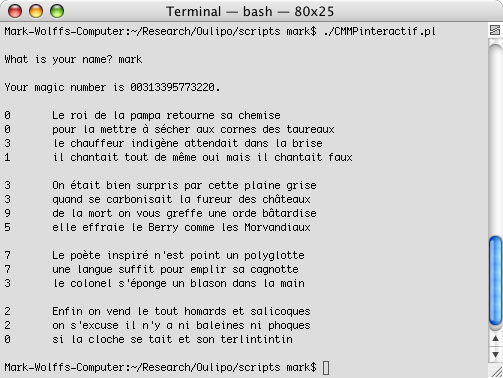
her to type it. It is not difficult to simulate ARTA's computer program to
produce poems from Queneau's original text by counting the number of seconds it
takes a user to type his or her name and using that information to calculate a
“magic number”:
Each digit in the magic number corresponds to a verse from one of the
original ten sonnets. The program's algorithm provides a certain degree of
interaction between the user and the machine, and the results of running the
program are theoretically reproducible if a user types the same name in the same
amount of time. The algorithm therefore has potential, but only insofar that it
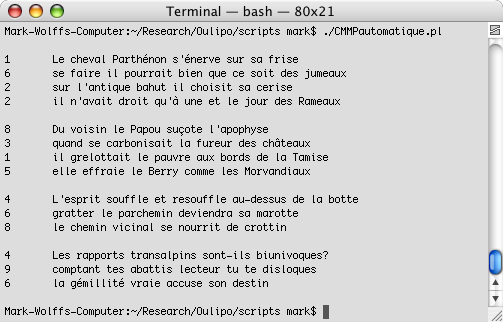
accelerates the production of poems. It may be easier and more entertaining to
generate poems automatically without relying on user input, and there are
several web sites on the Internet that do this. One could even use a random
number function:
Such a program has no potential in the Oulipian sense because random
numbers produce aleatory effects. The original algorithm preserves an active
role for the user, even if that role requires the minimal engagement of typing
one's name in order to sustain the creative process.
Paul Braffort and Jacques Roubaud, two Oulipians with backgrounds in mathematics
and computer science, formed the Atelier de Littérature Assistée par la
Mathématique et les Ordinateurs (ALAMO) in 1980 to explore computer-assisted
writing. Following the model of Queneau's
Cent mille
milliards de poèmes, the ALAMO wrote computer programs to produce
texts according to the rules of various genres, such as poems and aphorisms.
Braffort explained that combinatorial methods for generating texts with
computers fall into two categories. The first category, applicational methods,
involves templates for arranging words according to their grammatical function.
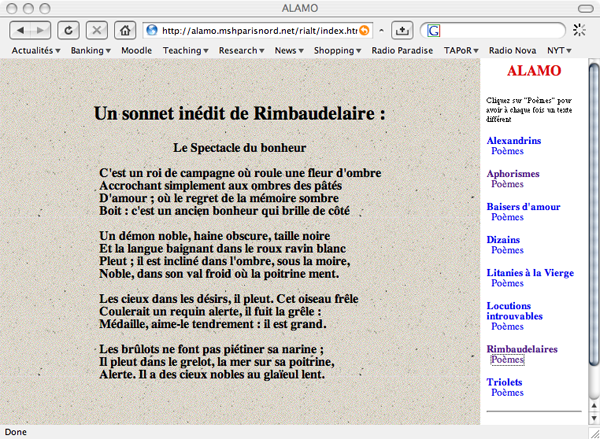
One particularly amusing application generates what the ALAMO calls
“Rimbaudelaires”, poems based on the structure of Rimbaud's poem
“Le Dormeur du Val” and composed of vocabulary
from Baudelaire's works:
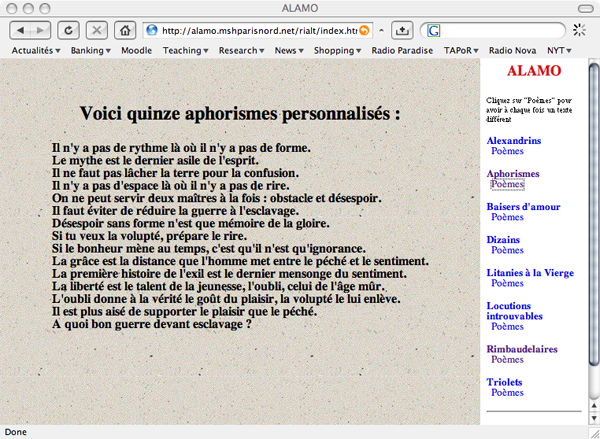
Another example is Marcel Bénabou's method for generating aphorisms
[
Bénabou 1980]. Braffort developed a program that
operationalized Bénabou's algorithm by abstracting the structures common to
adages and substituting new terms into the structures:
The potential of these computer programs resides in the way fragments
of words and verses are recombined according to a set of well-defined rules.
Poetic forms can thus be understood as algorithms for creating meaning with
language.
[1] The ALAMO devised ways to
formalize poetics in order for a computer to generate structured texts which may
or may not make sense. The actual poems produced by the programs are derivatives
of the way computers can be harnessed to explore language. Reading these
computer-generated texts can be amusing because of unexpected or incongruous
combinations of words that oddly make sense. Despite their uncanny effects,
however, texts produced through applicational methods still bear the mark of the
inventor who not only determines the templates into which syntagma are inserted
but also the stock of words and phrases from which the computer program
draws.
The second category, implicational methods, involves further abstraction of
structures. Instead of creating templates for arranging words according to
predetermined syntactic and semantic categories, the inventor devises rules for
making templates. According to Braffort, “implicational methods take a
further step [in the direction of invention]. The very logic of the
text is controlled by the program: a global syntagma comes into play
and becomes manifest as a supervisor of local syntagmas”
[
Braffort 1984, 18]. The logic of implicational methods relies on recursion in programs that
generate texts, allowing for systematic processing of linguistic elements below
the level of the “master” program. With recursion, computer programs can
continuously refine their output in ways the inventor would not be able to
easily predict. Implicational methods provide computers with a small measure of
independence. Braffort and the other members of the ALAMO developed a number of
formal systems for expressing the relationships between linguistic elements in
literary texts. One of these systems, FASTL (Formalismes pour l'Analyse et la
Synthèse de Textes Littéraires), used recursion and iteration to encompass all
forms of written communication. It is no accident that, with Braffort a computer
scientist and Roubaud a mathematician, FASTL resembles abstract systems of
representation used in the sciences: “USFAL [‘Un Système Formel pour
l'Algorithmique Linguistique’, a precursor to FASTL] will be
for theoretical literature what mathematical disciplines such as the
theory of differential equations can be for physics, economics,
etc.”
[
Oulipo 1981, 128]. An important feature of FASTL is its scalability in representing textual
elements. Text objects are organized within a hierarchy that extends from the
characters on a page or screen to entire libraries or corpora. Expressions for
representing relationships between objects at one level of the hierarchy should
be applicable to relationships of objects at another level within the hierarchy.
Algorithms for analyzing texts can potentially operate recursively:
For the mind of a mathematician,
we will say that the algorithm is a function that, when
applied to [a given text] considered as its argument
provides a result. This result is itself a text, but a
text with a complex organization that is highly structured with
fragments of symbolic texts and readings [...]
(Oulipo 1981, 133, author's emphasis.)
Given the scalability of FASTL and the possibility of recursion, abstract
representations of texts within FASTL could potentially undergo further
processing and abstraction. The complexity of texts as hierarchically structured
objects, however, makes devising an algorithm that operates from the level of
the word to that of the sentence, paragraph and chapter extremely difficult.
Nevertheless, the ALAMO's research into computer-assisted text analysis
envisioned the possibility of computational
mise en abîme
where the results of analysis can repeatedly feed as textual arguments into
algorithmic functions in a theoretically never-ending process. The Oulipo
anticipated the potentiality of recursion early in its history: in a report
submitted to the Collège de Pataphysique (an institution dedicated to the
pursuit of the “the science of exceptions”), the group proclaimed that
computers would make possible the
abstracting [of] commonplaces from
the structures of commonplaces — and then a “squared” topology of
these places, and so forth until one attains, in a rigorous analysis
of this regressus itself, the absolute, the
Absolute “whose armature,” according to Jarry, “is made of
clichés.”
[Motte 1986, 50]
The efforts of the ALAMO to develop computer applications that generate
texts through recursion have met limited success, however [
Braffort 2006].
As Braffort himself recognized, implicational methods for writing texts with
machines are related to research in artificial intelligence. The Oulipo does not
seek to replace the human writer who is at the center of the Oulipian
enterprise. The group's approach to automating potential literature follows the
Cartesian method of dividing a complicated question (how does writing occur?)
into smaller questions that are easier to solve. Recursion is one technique that
could allow humans to pursue new forms of writing by handing off some of the
work to machines. But where is the limit to recursion? In 1963 Jacques Duchateau
argued that what interests the the Oulipo most in machines is their capacity for
organizing information:
organized means that data will be
processed, that all the possibilities of the data will be examined
systematically according to a model that will be furnished eventually
by man or another machine, the model of which will also be furnished
by a third machine, the model of which, etc.
(in Bens 1980, 251)
Duchateau attempts to allay fears of an unintended determinism resulting
from the aleatory effects of rigorous textual constraints, but his notion of
organization does not make any distinction between humans and machines as
information processing units. His definition of organization is recursive: it
holds that a machine processes information according to a model based on another
machine, which in turn processes information according to the model of another
machine, etc. We might be tempted to think that for the Oulipo, humans are the
first machines after which all other machines are modeled, but Duchateau's
definition places humans and machines on the same ontological footing.
Ultimately there is no central processing unit which controls all the
subprocesses. The Oulipian inventor may create blueprints for literature, but he
distances himself from the work of applying rules and crafting texts. Despite
his privileged isolation from the particularities of writing, the inventor is
just another process that communicates with other processes.
If, as Duchateau explains it, the process of writing literature with machines
consists of organizing information in new ways to analyze and synthesize texts,
traditional authorship will eventually give way to a set of increasingly
anonymous and autonomous processes. During one of its reunions in the early
1960s the Oulipo anticipated the risk of automatism in the structures they were
defining. The group attempted to make room for individual freedom but they were
unable to reconcile freedom with automatism. Jacques Bens recognized that every
structure automatized writing to a certain extent, and Claude Berge added that
potential literature generated new automatisms [
Bens 1980, 144]. Le Lionnais insisted that a sufficiently complex system of constraints
offered writers a number of options from which they could choose. The Oulipians
wanted to avoid the unconscious automatisms of the Surrealists, but the
conscious use of structures in their writing produced what they could not avoid
describing as “automatic”. Le Lionnais admitted that “it is true that the birth of
machines has modified the current sense of the word ‘automatic’
”
[
Bens 1980, 185]. The Oulipo recognized that the problem of using computers to create
texts stemmed from the writer's inability to remain aware of how the machine
applied constraints. In the 1970s the Oulipo introduced the notion of the
clinamen, which helped to resolve this dilemma. Based on a conception of the
movement of atoms in Lucretius'
On the Nature of
Things, the clinamen is the primordial anti-constraint: it makes
creation possible by introducing chance and spontaneity in an ordered universe
[
Motte 1986]. The Oulipo recovered a sense of the unexpected
in the constraints they used but they wanted to define and control how chance
would play in their writing. An algorithm is productive as a tool for engaging
texts as long as the user can follow how the algorithm works and anticipate the
effects of chance. If the computational system becomes too complex or too
unpredictable, the act of interpretation will depend on opaque sequences of data
processing of which the user must remain unconscious.
The Oulipians developed at least two algorithms for reading texts. The first is
Harry Mathews's Algorithm, which consists of combinatoric operations over a set
of structurally similar but thematically heterogeneous texts. These operations
generalize the structure of the
Cent mille milliards de
poèmes and allow for the production of new texts. For instance,
given four texts each consisting of nine elements
| 1. |
a1
|
b1
|
c1
|
d1
|
e1
|
f1
|
g1
|
h1
|
i1
|
| 2. |
a2
|
b2
|
c2
|
d2
|
e2
|
f2
|
g2
|
h2
|
i2
|
| 3. |
a3
|
b3
|
c3
|
d3
|
e3
|
f3
|
g3
|
h3
|
i3
|
| 4. |
a4
|
b4
|
c4
|
d4
|
e4
|
f4
|
g4
|
h4
|
i4
|
Table 1.
Before applying Mathews's Algorithm
we can use Mathews's Algorithm to produce four new combinations:
| 1. |
a1
|
b2
|
c3
|
d4
|
e1
|
f2
|
g3
|
h4
|
i1
|
| 2. |
a4
|
b1
|
c2
|
d3
|
e4
|
f1
|
g2
|
h3
|
i4
|
| 3. |
a3
|
b4
|
c1
|
d2
|
e3
|
f4
|
g1
|
h2
|
i3
|
| 4. |
a2
|
b3
|
c4
|
d1
|
e2
|
f3
|
g4
|
h1
|
i2
|
Table 2.
After applying Mathews's Algorithm
In his
Exercices de style, Queneau relates the same
banal incident on the Paris bus system ninety-nine times, each instance
demonstrating a particular textual style. By identifying a nine-part structure
common to four of the exercises, one can apply Mathews's Algorithm to generate
four new versions of the incident (see
http://bumppo.hartwick.edu/Oulipo/Exercices.html). According to
Mathews, the the aim of the algorithm “is not to liberate potentiality
but to coerce it”
[
Motte 1986, 139]. A “new” reading of a text (or a reading of a “new” text)
through the algorithm is not the objective. The use of the algorithm is
meaningful in that the apparent unity of texts can be dismantled and give way to
a multiplicity of meanings. Mathews invented a system of constraints that
illustrates what poststructuralists have maintained for decades.
[2]
The second example is Raymond Queneau's matrix analysis of language, published in
Etudes de linguistique appliquée and discussed
at length during one of the Oulipo's early gatherings. Using principles of
linear algebra, Queneau devised a mathematics of the French language that
describes the construction of word groups. He began by dividing all elements of
speech into two categories: signifiers, which include nouns, adjectives, and
verbs (except
avoir and
être); and
formatives, which include everything else (
avoir,
être, pronouns, articles, conjunctions, prepositions,
adverbs, interjections, etc.). Given a word group such as a sentence, one can
construct two matrices where the first matrix contains all formatives and the
second all signifiers.
If a word group contains two consecutive formatives or signifiers, one
can use a unitary element in order to construct the matrices.
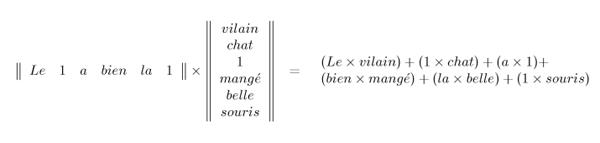
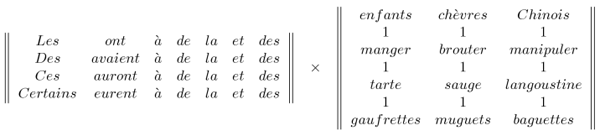
The product of a formative and a signifier is a bi-word. By adopting
the conventions that neither (1 × 1) nor (Y × 1) + (1 × Z) are allowed, one
avoids uninteresting or redundant bi-words. Where Y and Z are any formative and
signifier respectively, we can designate (Y × Z) as B, (Y × 1) as F and (1 × Z)
as S. This gives us BBB for Figure 5 and BSFBBS for Figure 6.
Queneau himself constructed matrices for a number of short sample texts, but his
ability to apply the algorithm to lengthy texts was limited because he did his
calculations manually. With the availability of part-of-speech taggers such as
Helmut Schmid's TreeTagger, it is relatively easy to perform a matrix analysis
of any text written in French with a computer [
Schmid 2006].
[3] Consider
the following representation of the first paragraphs of Flaubert's
Madame Bovary:
- [Nous 1][étions 1][à 1][l' Etude][ ,][quand 1][le Proviseur][1
entra]
- [1 suivi][d' 1][un nouveau][1 habillé][en bourgeois][et 1][d'
1]
- [un garçon][de classe][qui portait][un grand][1 pupitre][
.][Ceux 1]
- [qui dormaient][1 se][1 réveillèrent][ ,][et 1][chacun 1][se
leva]
- [comme surpris][dans 1][son travail.][Le Proviseur][nous fit][1
signe]
- [de 1][nous rasseoir][ ;][puis 1][ ,][se tournant][vers 1][le
maître]
- [d' études][1 :][ -][1 Monsieur][1 Roger][ ,][lui dit][-il 1][à
1]
- [demi-voix 1][ ,][voici 1][un élève][que 1][je 1][vous
recommande][ ,]
- [1 il][entre 1][en cinquième][ .][Si 1][son travail][et 1][sa
conduite]
- [sont méritoires][ ,][il passera][dans les][1 grands][ ,][où
1][l' appelle]
- [son âge.][1 Resté][dans 1][l' angle][ ,][derrière 1][la porte][
,][si 1]
- [bien 1][qu' 1][on 1][l' apercevait][à peine][ ,][le
nouveau][était 1]
- [un gars][de 1][la campagne][ ,][d' 1][une quinzaine][d'
années][environ 1]
- [ ,][et 1][plus 1][haut 1][de taille][qu' 1][aucun 1][de 1][nous
tous][ .][Il 1]
- [avait 1][les cheveux][1 coupés][1 droit][sur 1][le front][
,][comme 1]
- [un chantre][de village][ ,][l' air][1 raisonnable][et 1][fort
embarrassé][ .]
- [Quoiqu' 1][il 1][ne 1][fût 1][pas large][1 des][1 épaules][
,]
- [son habit-veste][de drap][1 vert][à boutons][1 noirs][1
devait][le gêner]
- [aux entournures][et laissait][1 voir][ ,][par 1][la fente][des
parements][ ,]
- [des poignets][1 rouges][1 habitués][à 1][être nus.][Ses
jambes][ ,][en 1]
- [bas bleus][ ,][1 sortaient][d' 1][un pantalon][1 jaunâtre][très
tiré][par 1]
- [les bretelles.][Il 1][était chaussé][de souliers][1 forts][
,][mal cirés][ ,]
- [1 garnis][de clous][ .]
Example 2.
Madame Bovary as a sequence of word
pairs
The text is broken down into bracketed pairs representing
bi-words, signifiers, formatives and punctuation. We can transform the text into
an abstract sequence of the letters F, S and B:
FFFB, FBSSFBSBFFBBBBS. FBSS, FFBBFBBBSFB; F, BFBBS- SS, BFFF, FBFFB,
SFB. FBFBB, BBS, FBBSFB, FB, FFFFBB, BFBFB, FBBF, FFFBFFFB. FFBSSFB,
FBB, BSFB. FFFFBSS, BBSBSSBBBS, FBB, BSSFBB, FB, SFBSBFBFBBS, B,
SB.
Example 3.
Abstract reduction of
Madame Bovary
Note that punctuation separates word groups. One can compute the
probability ratios of formatives (F), signifiers (S) and bi-words (B) in a text:
| F |
= 55 |
0.369127516778524 |
| S |
= 28 |
0.187919463087248 |
| B |
= 66 |
0.442953020134228 |
Table 3.
Probabilty ratios in the passage from
Madame
Bovary
F + S + 2B always equals the total number of words in a text.
Queneau believed that matrix analysis could provide “indices of an author's style
that may be interesting, for they escape the conscious control of the
writer and doubtless depend on several hidden parameters”
[
Queneau 1965, 319]. He did not elaborate further on how one could determine such indices,
but his matrix analysis can be combined with the use of Markov chains in order
to measure the authorship of texts. Given the four letters F, S, B and P to
designate formatives, signifiers, bi-words and punctuation, we can construct a
transition matrix of the probabilities of letter sequences in the passage from
Madame Bovary:
|
S |
F |
B |
P |
| S |
0.23809524 |
0.33333333 |
0.23809524 |
0.19047619 |
| F |
0.00000000 |
0.32727273 |
0.61818182 |
0.05454545 |
| B |
0.17391304 |
0.17391304 |
0.27536232 |
0.37681159 |
| P |
0.12121212 |
0.51515152 |
0.33333333 |
0.03030303 |
Table 4.
Transition matrix of passage from
Madame
Bovary
Note that the probability of the sequence FS is zero because such a sequence would
be an instance of a bi-word. Dmitri Khmelev and Fiona Tweedie have developed a
technique for determining authorship using Markov chains and transition matrices
for the sequence of letters in a text. Their technique can also be used with
formatives, signifiers, bi-words and punctuation. Given a text of which the
author is one of a group of known authors in a corpus, we can determine the
probability that the text in question was written by each of the known authors.
I have used this technique with a corpus of 1569 texts written by 290 authors
from the ARTFL database (
http://humanities.uchicago.edu/orgs/ARTFL/). I first selected
randomly a text from each author in the corpus. Of the 290 randomly selected
texts, 186 were correctly attributed to the authors who wrote them, or 64
percent. According to Khmelev and Tweedie, this represents an error rate of
0.153 percent. I then performed a cross-validation of the ARTFL corpus where 557
texts were correctly classified by author. These results are similar to those of
Khmelev and Tweedie, suggesting that the combination of matrix analysis and
Markov chains offers an interesting technique for measuring “linguistically microscopic” data to determine
the authorship of texts written in French [
Khmelev and Tweedie 2001, 302–4].
[4]
Whatever the promise of matrix analysis in providing quantitative evidence for
measuring an author's style, Queneau expressed greater interest in its
mathematical properties. He proved several theorems on the behavior of matrices
and identitified similarities between them and the Fibonacci series [
Queneau 1964]. He also explored the potentiality of matrices
without basing his analyses on written texts. He and the other members of the
Oulipo were intrigued by matrix analysis but looked forward to the creation of
poems written in columns and rows (
in Bergens
61–66):
Matrix analyis can help discover the “hidden parameters” of an
author's style, and we could consider it as an interesting example of
Anoulipism, or the discovery of potentialities in existing texts. The Oulipo
believed, however, that Synthoulipism, or the invention of potentialities for
future texts, was its “essential vocation”
[
Motte 1986, 27]. The combinatorics of non-linear, two-dimensional poems invite the
development of computer applications for generating and analyzing a new kind of
text. Whether anyone will go to the trouble to write and read matrix poems is a
question the Oulipo has not pursued, in part perhaps because it would involve
realizing concrete techiques and practices that would no longer be
potential.
Mathews and Queneau offer two algorithms for creating meaning with language that
demonstrate the Oulipo's efforts to imagine potentialities for literature, “if need be through recourse to
machines that process information”
[
Motte 1986, 27]. We can operationalize these algorithms with computers for literary
analysis “if need be”, but the interest of the algorithms lies not in what
they help us see in a given text but in the way they invite us to play
rigorously for play's sake. Recent efforts to reconceptualize text analysis with
computers have tried to imagine how computers can be used as tools for
discovering new ways to make sense of texts. The Oulipo proposes something more
radical: to borrow a turn of phrase from Jerome McGann, the invention of
algorithms can create potentialities for imagining what we do not know about
textuality in general. Given a rigorous constraint on the use of language, what
does the constraint itself do? Does it offer new possibilities for meaning? If
so, how? Oulipian constraints are better understood as toys with no intended
purpose rather than as tools we use with some objective in mind. The procedures
for making sense of texts are meaningful in and of themselves. They are not only
instruments for discovering meaning but also reflections on making meaning. The
distinction I have made between writing and reading follows what the Oulipo has
and has not articulated in the theory of its practice. In the end, the need for
a distinction becomes unnecessary when one observes that all encounters with
textuality invite the application of rules that lead the writer and the reader
to see unanticipated potentialities in language. Humanities computing should
make room for playing with tools without concern for specific output and
outcomes. In doing so, it will open itself to new theoretical possibilities of
textuality, creating opportunities for what we could call “pure” research
that may (or may not) draw interest from the broader humanities community.
Works Cited
Bens 1980
Bens, Jacques. Oulipo
1960-1963. Paris: C.
Bourgois, 1980. Republished as Genèse de l'Oulipo 1960-1963.
Bordeaux: Le Castor Astral,
2005.
Bergens 1999
Bergens, Andrée. Raymond
Queneau. 1975. Paris:
L'Herne, 1999.
Braffort 1984
Braffort, Paul. “La littérature
assistée par ordinateur”, Action
Poétique 95 (1984): 12-20.
Bénabou 1980
Bénabou, Marcel. “Un aphorisme peut en
cacher un autre”. 1980. La
Bibliothèque oulipienne, vol. 1, Paris:
Editions Ramsay, 1987,
251-269.
Khmelev and Tweedie 2001
Khmelev, Dmitri V., and Fiona J. Tweedie.
“Using Markov Chains for Identification of
Writers.” Literary and Linguistic Computing 16.3
(2001): 299-307.
McGann 2001a
McGann, Jerome. Radiant Textuality:
Literature After the World Wide Web.
New York: Palgrave Macmillan,
2001.
Motte 1986
Motte, Warren F., Jr.
“Clinamen Redux”, Comparative Literature Studies.
Olsen 1993
Olsen, Mark. “Signs, Symbols and
Discourses: A New Direction for Computer-Aided Literature
Studies”, Computers and the
Humanities, 27 (1993): 309-314.
Oulipo 1981
Oulipo. 1981. Atlas de
littérature potentielle. Paris:
Gallimard, 1981.
Oulipo 1998
Oulipo. Oulipo: A Primer of Potential
Literature.
1986. Ed. and trans. Warren F. Motte, Jr. Normal,
IL: Dalkey Archive Press,
1998.
Queneau 1961
Queneau, Raymond. Cent mille
milliards de poèmes. Paris: Gallimard,
1961.
Queneau 1964
Queneau, Raymond. “L'Analyse
matricielle du langage”, Etudes de
linguistique appliquée (1964): 37-50.
Queneau 1965
Queneau, Raymond. Bâtons, chiffres et
lettres.
Paris: Gallimard,
1965.
Ramsay 2003
Ramsay, Stephen. “Toward an
Algorithmic Criticism”, Literary and
Linguistic Computing 18.2 (2003): 167-174.
Reggiani 1999
Reggiani, Christelle. Rhétoriques de
la contrainte: Georges Perec — L'Oulipo .
Paris: Editions
Interuniversitaires, 1999.
Rockwell 2003
Rockwell, Geoffrey. “What is Text
Analysis, Really?”, Literary and
Linguistic Computing 18.2 (2003): 209-219.
Sinclair 2003
Sinclair, Stéfan. “Computer-Assisted
Reading: Reconceiving Text Analysis”, Literary and Linguistic Computing 18.2 (2003):
175-184.
Starynkevitch 1990
Starynkevitch, Dmitri. “The SEA CAB
500 Computer”, Annals of the History of
Computing 12.1 (1990): 23-29.