Abstract
Because so little primary historical work has been done on the classic text computer
game “Colossal Cave Adventure”, academic and popular
references to it frequently perpetuate inaccuracies. “Adventure” was the first in a series of text-based games
(“interactive fiction”) that emphasize exploring, puzzles, and
story, typically in a fantasy setting; these games had a significant cultural impact
in the late 1970s and a significant commercial presence in the early 1980s. Will
Crowther based his program on a real cave in Kentucky; Don Woods expanded this
version significantly. The expanded work has been examined as an occasion for
narrative encounters [Buckles 1985] and as an aesthetic masterpiece of
logic and utility [Knuth 1998]; however, previous attempts to assess
the significance of “Adventure” remain incomplete without
access to Crowther's original source code and Crowther's original source cave.
Accordingly, this paper analyzes previously unpublished files recovered from a
backup of Woods's student account at Stanford, and documents an excursion to the
real Colossal Cave in Kentucky in 2005. In addition, new interviews with Crowther,
Woods, and their associates (particularly members of Crowther's family) provide new
insights on the precise nature of Woods's significant contributions. Real locations
in the cave and several artifacts (such as an iron rod and an axe head) correspond
to their representation in Crowther's version; however, by May of 1977, Woods had
expanded the game to include numerous locations that he invented, along with
significant technical innovations (such as scorekeeping and a player inventory).
Sources that incorrectly date Crowther's original to 1972 or 1974, or that identify
it as a cartographic data file with no game or fantasy elements, are sourced thinly
if at all. The new evidence establishes that Crowther wrote the game during the
1975-76 academic year and probably abandoned it in early 1976. The original game
employed magic, humor, simple combat, and basic puzzles, all of which Woods greatly
expanded. While Crowther remained largely faithful to the geography of the real
cave, his original did introduce subtle changes to the environment in order to
improve the gameplay.
Introduction
Will Crowther's “Colossal Cave Adventure” was neither the
first computer game nor the first program to emulate conversation
[1]; nevertheless, “Adventure” — an interactive
textual simulation of a caving expedition, augmented by fantasy-themed puzzles –
inspired a generation of hackers. Playing “Adventure”
involves reading prose descriptions of the setting, and typing brief commands (i.e.
“light lamp”) in order to solve puzzles and collect
treasure. Similar text games representing environments defined both by story and
rules were extremely popular during the 80s and (with the addition of graphics)
through the 90s. Text-adventures, also known as “interactive fiction”
(IF),
[2] attracted modest scholarly attention as an emerging
literary form in the 80s;
[3] yet “[m]ost commentators and critics of the adventure game
genre… fail to mention the original
Adventure
at all, and those who do usually date it far off the mark… and often neglect
to mention its creators”
[
Aarseth 1997, 107]. The resulting vacuum has attracted memes, some so firmly lodged in our
inventory of digital lore that they regularly appear without citation. In order to
map out the groundwork for a more accurate assessment of “Adventure”, its innovations, and its legacy, this study draws on two
crucial resources previously unexamined by digital scholars: Crowther’s original
source code and Kentucky’s original source cave.
Levy observes that “like any significant program, Adventure was expressive of
the personality and environment of the authors”
[
Levy 1984, 133]. Due to Crowther's personal choice to keep a low profile,
[4]
analysis of “Adventure”
[5] must
rely more heavily on the environment — both professional and natural. We know
Crowther's coding environment was collaborative and highly technical,
[6]
but so far we have only known Crowther's “Adventure”
indirectly, through a version greatly expanded by Don Woods.
Section 2 of this article is a formal examination of
Crowther's original source code files, offering, for the first time, a clear
understanding of Crowther's innovative blend of simulation and fantasy, as well as a
better appreciation of the creative contributions of Woods.
Section 3 compares the game to maps of the cave site, presents
photographs of an excursion to Colossal Cave, and offers testimony from experienced
cavers. These key sources — the code and the cave, analyzed here for the first time
– establish that Crowther's original was not only faithful to the geography of the
real Colossal Cave, but was also a fantasy remediation of that site.
Section 4 offers a revision of the “Adventure” timeline in an attempt to correct common
misconceptions and encourage further scholarship, and a brief
conclusion compiles the major formalist observations,
as a gesture towards encouraging further research.
Taking Inventory of “Adventure”
While today's young computer professionals may have only passing familiarity with
“Adventure”, the game had a tremendous effect on
an earlier generation of programmers. Lines from “Adventure”, such as “You are in a maze of twisty
little passages, all alike” and the magic word “XYZZY”, quickly entered hacker culture.
The New
Hacker Dictionary
[7] includes the term “vadding” (“from VAD, a permutation
of ADV (i.e., ADVENT), used to avoid a particular admin's continual
search-and-destroy sweeps for the game”), defining it as a “leisure-time activity of certain hackers involving the
covert exploration of the ‘secret’ parts of large
buildings”
[
Raymond 1996, 465].
Successors to “Adventure” were among the best-selling
computer games of the 1980s. Even after the commercial market faded, hobbyists
continued to play, review, and create interactive fiction. Indeed, the
post-commercial IF community
[8] was producing valuable analysis and theory
[9] long before games began to emerge as an
academic subject.
Within the computer science field,
Knuth (1998)
used “Adventure” as his sole example in a 107-page
tutorial on “literate programming” — coding for human readers as
well as machines. His text carefully translates the Crowther/Woods FORTRAN code
to CWEB, prefacing each section of code with a discussion of how the rules
defined in each section of code affect the gameplay.
You get to wander around until you've located all fifteen
treasures, although you need not have taken them yet. After that, you enter
a new level of complexity: A global variable called clock1 starts ticking downwards, every time you take a turn inside the
cave. When it hits zero, we start closing the cave; then we sit back and
wait for you to try to get out, letting clock2 do the
ticking.
[Knuth 1998, 80]
Knuth expects his reader to have played “Adventure”
multiple times, but offers his close reading of the code as the proper way to
experience the work. His approach is the mirror image of
Buckles (1985), whose dissertation on “Adventure” employs literary formalism to examine what
she calls a “storygame” in terms of established
genres such as the riddle and the folktale. Where Knuth’s procedural formalism
argues “you cannot fully appreciate the astonishing brilliance
of its design until you have seen all of the surprises that have been
built in [the code]”
[
Knuth 1998, 1], Buckles explores the narratives that her volunteer players generated as
they attempted (often unsuccessfully) to make sense of their partial exposure to
the simulated world. While Knuth and Buckles could hardly approach their subject
more differently, both studies take “Adventure” as a
given, without examining the cultural context in which Crowther and Woods
created the text, or the context in which its first players interpreted it.
Twisty Little Passages
[
Montfort 2003], which takes its title from an infamous maze in
“Adventure”, presents a detailed analysis of the
cultural origins and significance of “Zork”, a
similar game that was inspired by “Adventure”
[
Anderson 1985]. While Montfort offers an excellent overview of
canonical knowledge about “Adventure” and later
developments in the genre of interactive fiction, much basic scholarly work on
“Adventure” has remained.
[10]
Despite the historical importance of text adventures (they created the first
market for home computer games), IF has only rarely attracted serious attention
from digital scholars. Notable exceptions include Aarseth's reading [
Aarseth 1997] of Marc Blank's 1982 “Deadline”, and, of course, Montfort's ongoing work.
[11] Nevertheless, Aarseth's complaint
about authors who overlook “Adventure” remains valid.
Murray mentions “Adventure” only in an end note,
describing Crowther's original as a 1972 map and attributing the fantasy
elements entirely to Woods [
Murray 1997, 290]. Douglass uses
the more accurate date of 1975, but re-affirms a stubborn meme when he describes
“Adventure” as a “spelunking simulation… expanded by Don Woods into a
Tolkein-esque fantasy”
[
Douglass 2007, 129]. A recent article in the
New York Times
completely overlooks “Adventure”, stating “Zork introduced the world to the adventure game”
[
Chaplin 2007]. Yet Costikyan is too scrupulous, using
Colossal
Cave to refer to the Crowther original and
Adventure to refer to the Woods expansion, representing them as two
different examples of interactive fiction [
Costikyan 2007, 5]. While other scholarship focusing on more recent works of interactive fiction
includes Douglass's analysis of Plotkin's 2000 “Shade” and brief author notes by Montfort, Meretzky and Short [
Harrington and Wardruip-Fruin 2007], and Keller's ethnographic “Gaming, Identity and Literacy”
[
Selfe and Hawisher 2007], the historical and cultural role of “Adventure” itself remains under-examined.
In the realm of journalism,
Dibbell (2002)
revisits and summarizes canonical sources on “Adventure”, drawing on sources such as
Nelson
(2001) and
Aarseth (1997), but the
article, written for a general reader, contributes no new knowledge.
Douglass (2006) lists “a
fairly constrained set of talking points” that gaming and mainstream
articles about interactive fiction typically follow: for instance, works of IF
“started the computer game industry”, “were killed by graphics cards”, and “are still being made!” The formulaic nature of these
stories is due in part to the journalist's obligation to introduce readers to an
unfamiliar genre; regrettably, such boilerplate coverage can perpetuate faulty
assertions. A March 2002
GameSpy article is a
typical example of the resilience of various memes that have entered the realm
of common knowledge:
The year was 1972. Crowther, an amateur spelunker
distraught over a recent divorce, wanted to create a game that he and
his kids could play on the computer together. He whipped up a computer
text simulation of the Mammoth Caves in Kentucky... Of course there were
no puzzles in Crowther's version, just a mighty underground realm to
explore. Enter Don Woods, who found a copy of the game on the primitive
Internet. He asked permission to play with the source code and the
result was Adventure (sometimes called Colossal
Caves). He added treasures to collect, monsters, traps,
puzzles, and more.
[Gamespy 2002]
Little evidence has been available to challenge many of these assumptions, as
well as others (such as the claim that Crowther based his game not on Colossal
Cave but a nearby cave named Bedquilt, or that Don Woods hacked his way into
Crowther's account). New interviews with Crowther, his family members, and his
associates (see
Section 4) establish that
Crowther
did present his game as a post-divorce activity for his
children (although he also shared it with his Dungeons and Dragons friends);
Crowther
was a caver (but “In those days, the
thing I cared most about was rock climbing,”
[
O'Neill 1990, 5]); the game
was based on one
section of the Mammoth Cave system in southwestern Kentucky, which contains
Colossal Cave (a sub-network with many entrances, of which Crowther featured one
named Bedquilt); and Stanford University graduate student Don Woods
did find Crowther's abandoned program (not by hacking, but simply
by playing a copy that someone else had placed on a computer at the Stanford
medical school; see
Cordella [2001]). Woods
had previously estimated a March or April 1976 release date [
Cordella 2001], but now he agrees with the 1977 claim made by the
present study [
Woods 2007].
Crowther's original source code,
[12] which had been presumed lost for decades, was recovered in 2005
from a backup of Don Woods's student account at the Stanford Artificial
Intelligence Lab (SAIL).
[13] The
recovered files, dated March 1977, and bearing the in-game message “WELCOME TO ADVENTURE!!”, confirm that Crowther's
original was in fact a game, with puzzles (such as a sequence that involves
interactions between a rusty rod, an empty birdcage, a bird, and a snake),
subtle humor (such as the surprising way that the bird helps the player get past
the snake), and fantasy (including a magical crystal bridge, magic words, and
combat with axe-wielding dwarves). Yet Crowther's adventures in Colossal Cave
began earlier, via the Cave Research Foundation (CRF). Several caving resources
shed light on the pre-history of “Adventure”,
including Crowther’s 1975 map of the Bedquilt region of Colossal Cave (sometimes
confused with Crowther's original game), and a manual describing recreational
caving as the CRF practiced it in the mid 70s. Insights gained from a recent CRF
expedition to Colossal Cave — together with an analysis of the recovered source
code and new feedback from Crowther, Woods, and others with knowledge of the
original “Adventure” — clarify our understanding of
an important digital artifact.
Cultural and Commercial Impact
When “Adventure” reached MIT in the spring of 1977,
one group of players reacted by creating “Zork” and
the company Infocom, whose text-adventure titles were best-sellers during the
80s. Other entrepreneurs inspired by “Adventure”
included Scott Adams (founder of Adventure International), who published the
lean but accessible “Adventureland” in 1978, and Ken
and Roberta Williams (co-founders of Sierra On-Line), who produced the first
graphic adventure game (“Mystery House,” 1980) after
Roberta got hooked on “Adventure”
[
Levy 1984, 294–295]. In 1978, Atari employee Warren Robinett
reworked the general exploration-and-treasure premise into a 2D graphic game,
also called “Adventure”, which sold a million units
[
Robinett 2000]. During the late 70s, text-based computer
games had tactical advantages over games using the slow, blocky, and expensive
graphics that were then cutting-edge.
The day I discovered Dungeon [the mainframe, pre-commercial
version of Zork] I decided the computer room was the best place at
school….We had no color monitors, no videogames to play. Everything here was
text, blocky white letters on black screens. Yet the words were seductive
because they revealed a hidden order behind everything...
[Bennahum 1998, 106, 108]
Last year's graphic games dated quickly due to rapid hardware advances, while
last year's text games still appealed to this year's text gamers, which helped
sales. Text games were also easily portable to multiple platforms, thereby
increasing sales potential in a crowded market. When the PC and Mac emerged as
the dominant hardware platforms in the late 80s, both the aesthetic and economic
advantages of text adventures evaporated.
Nevertheless, many things that “Adventure” players
enjoyed — logic and resource-management puzzles and the exploration of a complex
virtual topography within the context of a framing story — remain staples in
adventure, role-playing, and multiplayer game genres. Further, many elements
that “Adventure” did not implement — complex
non-player characters, believable AI, dynamic branching plots — still elude
today’s game designers. Former Infocom supervisor Dan Horn, reflecting on
Infocom's failure to secure a foothold in the emerging multiplayer, real-time
role-playing genre, blames his company's “bad business
decisions. Imagine if you will [Infocom's] Sorceror, Planetfall, and
Deadline with the EverQuest [graphical] engine, amazing... but lost forever”
[
Briceno et al. 2000, 44]. In a review of Electronic Entertainment
Expo 2000,
Au (2000) describes the action-centered
blockbuster mentality that tends to obscure the importance of innovative niche
titles: “Lured by the siren song of ever-improving graphics
power, terrified by the risks involved with truly unique ideas in gaming,
the industry is collectively stumbling along a path well-worn by
Hollywood,” which uses non-stop action and visual spectacle to compete
against itself for the quickest path to the consumer's dollar. A 2002 column in
the
New York Times suggested that the commercial
gaming industry's quest for graphic realism is misguided, and perhaps even at
odds with the elemental pleasure of identifying and mastering a set of rules:
“One of the major goals of video game systems has been
to simulate the real, to create images so lifelike, and movements so natural
that there is no sense of artifice,” yet paradoxically, “the technology is put in service to creating a world that
could very well do without it”
[
Rothstein 2002]. Because interactive fiction authors can draw on
an existing body of narrative techniques, as well as emergent code-based
interaction techniques, the medium (free from the corporate pressures associated
with team-based development) is well-suited to individual experimentation and
innovation.
Story, Rules, and Interactive Fiction
Observing the joint activities of Hollywood and Silicon Valley, Poole speaks
optimistically of a
new pragmatism among video game designers: concentrating
on what they alone can provide, rather than chasing the fashionable
dream of interactive narrative, or uncritically seeking convergence with
the cinema. Instead, especially in their concentration on character,
videogames are carefully strip-mining our conventional notions of
narrative and storytelling for what can be usefully simulated in their
own, utterly different, medium.
[Poole 2000, 111]
According to Poole, narrative-driven games that aim to model personality
are advancing an effort begun by text-adventures, which were, during the 80s, “the most promising avenue for success in this field”
[
Poole 2000, 106]. Poole's intimate knowledge of contemporary gaming culture offers more
first-person acuity than the influential
Hamlet on the
Holodeck
[
Murray 1997], which draws more insight from gamer narratives (and
analyses of game-like experiences in
Star Trek)
than from the games themselves. Eskelinen is, however, too harsh [
Eskelinen 2001] when he takes Murray to task for interpreting the
Russian “Tetris” as a commentary on disorder in the
overly-scheduled American lifestyle. To Eskelinen, Murray commits “interpretive violence” by ignoring “the actual game” and instead trying “to
interpret its supposed content, or better yet, project her favourite content
on it.” Murray's approach fails, according to Eskelinen, because
“consequently we don't learn anything of the features
that make
Tetris a game”. By dismissing
the value of examining his subject through any critical lens other than strict
digital formalism, Eskelinen cleaves exclusively to one side of an unnecessary
fissure between rules-based (ludological) and story-based (narratological) modes
of games scholarship.
[14] This apparent opposition
illustrates the postmodern assertion that, owing to the socially-constructed
nature of “meaning,” different readers will
inevitably find different meanings in a given text. For example,
Buckles (1985) investigates the unique
narratives that “Adventure” players constructed,
examining how these stories helped players construct a working understanding of
the game's puzzles. Such an approach privileges the perspective of a payer
without access to the source code, yielding insights that differ from those
achieved through Knuth’s code-based approach, which does not examine the role
imagination plays in retaining (or losing) the player’s interest when the rules
seem impenetrable. When discussing the postmodern emphasis on the reader's
interpretive act rather than the writer's authorial power,
Hutcheon (1988) offers the textual variability
of interactive fiction as “the most extreme example I can think of”
[
Hutcheon 1988, 77]. A binary approach to digital formalism does not mesh well with the
axiom, familiar to literary critics, that seeking out diverse and indeed
conflicting interpretations of a bounded text is a normal component of the
acquisition of knowledge (so long as these interpretations are supported by
evidence, thereby anchoring the interpretation on the safe side of the slippery
slope).
Hutcheon's observation highlights Aarseth's distinction between the infinite
variable
interpretations of any traditional text and the
constrained variable content of a cybertext (1997, p. 3). Even after accepting
that variable
content is a defining principle of a cybertext, we
are still free to recognize that variable content is as open to variable
interpretation as any fixed text. For example, to a generation
raised on
Star Trek or to scientists familiar with
the latest chatterbots, Weizenbaum's “ELIZA” (1966)
seems unimpressive as an implementation of artificial intelligence; yet when
examined as a controlled expression of the angst that many in the general public
felt about contemporary technology, or when taken as a withering parody of a
touchy-feely 1960s psychiatrist, the same program gains new relevance. Poole
quotes Richard Darling (a developer with the British company Codemasters)
regarding the “ELIZA”-as-game: “I
think, that in the games world, [artificial intelligence] hasn't to me
actually exceeded that excitement level”
[
Poole 2000, 107]. In fact, because it had such a big impact
on non-specialists who had previously seen nothing like it, “ELIZA” may be more
culturally significant than the more
sophisticated chatterbots that followed it. But perhaps even more fundamental is
the observation that humans reach for anthropomorphic images when confronted
with computer behavior that they do not understand; the name given to this
tendency — the “ELIZA effect” — is one example of the
program's cultural legacy. “Tetris” has its own
cultural legacy; Murray presumably encountered the game within the context of
her own overscheduled American lifestyle. The marketing emphasized the game's
Soviet origins, capitalizing on the American consumer's interest, during the
last years of the Soviet Empire, in participating — at least symbolically — in
glasnost and
perestroika, therefore
giving casual gamers a reason to try a title that might not otherwise have
appealed to them. The “actual game,” then, is not
only the set of abstracted rules that interests Eskelinen, but also a cultural
artifact upon which humans (from marketers to players to games scholars) project
their own concept of meaning according to their own unique values.
[15]
The first comprehensive assessment of the cultural history of interactive fiction
is found in Nelson's
Inform Designer's Manual 4th
ed. [
Nelson 2001] (an encyclopedic reference for one of several
highly-advanced programming languages used by the interactive fiction hobbyist
community). An appendix offers an overview of the genre, beginning with the
story of Stephen Bishop, a cave explorer, cartographer, and former slave, who
worked as a tour guide in Colossal Cave in the hopes of buying freedom for his
wife and children. “It's hard not to feel a certain sadness
that the first adventure game was shaped by those two lost souls, Bishop and
Crowther, each like Orpheus unable to draw his wife out of the underworld”
[
Nelson 2001, 344]. While the comparison of a cave beloved by
both men to slavery, divorce, and death may seem melodramatic, Nelson aptly
identifies the pathos which contextualizes the adventures Bishop and Crowther
experienced in Colossal Cave. For Crowther's children, Sandy [
Lawrence 2002] and Laura [
Carter 2002], playing
computer games (including their father's original game, and later the version
Woods expanded) was always part of visiting their father after the divorce. One
of Crowther's former caving companions recalled CRF culture in the early 70s in
utopian terms, describing the breakup of the Crowthers' marriage as a
catastrophic event; this mutual friend was himself clearly suffering 30 years
later. Another caver who was with the Crowthers on an expedition in the summer
of 1975 reports that one glance at “Adventure” was
enough to identify it immediately as a cathartic exercise, an attempt by Will to
memorialize a lost experience.
“Adventure” was written for fun and shared for free;
it was the cultural product of an educated, puzzle-loving, and fundamentally
altruistic geek culture. Had it been better suited to the expectations of the
non-technical public, it would likely have been less interesting to the
community of computer specialists and entrepreneurs who responded by creating
their own variations. In his editorial in the first issue of
Game Studies,
Aarseth
(2001) sketches a game studies manifesto urging scholars to examine
not only the huge industrial players, but also the activities of the “world-wide, non-commercial, collective games movement.”
Writing of the game modding community,
Au (2002)
observed that mods (amateur variations upon and expansions for commercial
products) “represent the most visible success of the free
software movement on the larger culture. For the millions who play computer
games, the same ethos of volunteerism and shared ownership that
characterizes free software has helped utterly transform the gaming
experience and the $8 billion-plus gaming industry.” In a similar
vein,
Ryan (2001) articulates a vision of what
might happen “if computer games could emancipate themselves
from the tyranny of the market,” which, as is the case in Hollywood,
forces developers to appeal to the broadest audience. Contrasting the high
overhead of games with the low cost of producing literature, Ryan posits that “if games could enjoy a comparable freedom of
expression, we might see hybrids of literature and games which would
place greater aesthetic emphasis on the plot”
(
fn. 9). There are, of course, computer games that succeed without compelling
plots; however, by nature, interactive fiction invites and rewards a
narratological approach more readily than other gaming sub-genres.
Poole observes that a generation ago, cinema and jazz studies occupied only
marginal spaces in academia; yet they are today considered respectable subjects
for examination (13). A close relation of the adventure game, the MUD, has
already drawn considerable academic attention.
[16] The rhetorical connections between contemporary IF
and MUDs have not been fully explored, even though the first MUD was a hacked
version of a text adventure game. Arguing against the received notion that
advances in computer technology have made IF irrelevant,
Cadre (2004?) introduces his own collection of
avant-garde IF titles by claiming “the
medium
of interactive fiction is no more a relic of the 1980s than the novel is a
relic of the 17th century”. With three decades of history but with so
little basic research published, the text adventure genre remains a promising
subject for digital humanities research.
Exploring Colossal Cave in Code
His daughter Sandy quotes Will Crowther as saying, “You know I've
done all sorts of wonderful things in my career, it's funny that the one thing
I'm remembered for is ‘Adventure’
”
[
Lawrence 2002]. Before he coded his legendary game, Crowther had
helped map the complex network of caverns on which the game is based; and before
that, he had already secured a place in history due to his
contributions to a different network. As a member of the team of programmers at
Bolt, Beranek and Newman (BBN), he helped create the ARPANET, the immediate
forerunner to the internet.
Historical and Cultural Context
While BBN was actively researching artificial intelligence at the time Crowther
was building “Adventure”, the game “was just some rather simplistic logic and a small table of
known words — of course backed up by some very clever thinking,”
according to
Kraley (2004), whose office was
across from Crowther's. Kraley joined Crowther in a months-long Dungeons and
Dragons campaign (led by Eric Roberts and including future Infocom co-founder
Dave Lebling among the core of about eight participants). “[O]ne day, a few of us wandered into [Crowther's] office so he could show
off his program. It was very crude in many respects — Will was always
parsimonious of memory — but surprisingly sophisticated. We all had a blast
playing it, offering suggestions, finding bugs, and so forth.”
Crowther's original Adventure impressed his colleagues. “Will was very proud - or more accurately amused - of how well he could fool
people into thinking that there was some very complex AI behind the
game,” according to Kraley. Nevertheless, “once it
was working, Will wasn't very interested in perfecting or expanding
it.”
Crowther has described himself putting a copy of the game on his BBN computer,
leaving for a month's vacation, and returning to find the game being played all
over the internet [
Hafner 1994]. Among those who found the game at
this stage were two Stanford graduate students, Don Woods and John Gilbert.
According to
Gilbert (2005), someone (possibly
the instructor, Bob Floyd) mentioned the game in their CS204 class (a “programming and problem-solving seminar”) — after which
Gilbert and Woods “stayed up all night at the AI lab playing
the game and mapping the cave, including scanning the binary code for
character strings in order to guess what the possibilities were.”
After contacting Crowther and requesting the source code, Woods greatly
increased the game's size, complexity, and polish. “In early 1977…. [w]hen
Adventure arrived at MIT, the reaction was typical: after
everybody spent a lot of time doing nothing but solving the game (it's
estimated that
Adventure set the entire
computer industry back two weeks), the true lunatics began to think
about how they could do it better”
[
Anderson 1985]. During this time, Tom Van Vleck was a managing engineer at Honeywell. He
describes “Adventure” as just another fad. “[S]ome staff members spent many hours at it. Others
played it once or twice, showed it to relatives and friends, and lost
interest. Gaming was not a source of interest in computing, or a way of
recruiting people to the field: it was something we could do with the
machine that was comprehensible to non-computer folks, who were often
baffled about what a computer was and what we did”
[
Van Vleck 2001]. But at MIT, a group of hackers was sufficiently captivated by “Adventure” that they developed a similar game, “Zork,” along with a company, Infocom, to market it [
Anderson 1985]; [
Briceno et al. 2000].
Analysis of Crowther’s Source Code
The earliest source code for Crowther's PDP-10 “Adventure” game [
Crowther 1976], exists in two FORTRAN
files — one for data, and one for code, dated 11 Mar 1977. According to
Woods (2007), these files show the program as
Crowther left it, before Woods began debugging and expanding the code. The data
file comprises six separate tables that contain most of the game's text: 1) long
descriptions, 2) short room labels, 3) map data, 4) grouped vocabulary keywords,
5) static game states, and 6) hints and events. Embedded in the code file are
the static components of variable strings, such as “ I SEE
NO ‘,A5,’ HERE.” (where “A5” represents the name of an object). All text was
written in all-caps due to the limitations of the PDP-10.
Table 1 [Long Descriptions]
- 1 YOU ARE STANDING AT THE END OF A ROAD BEFORE A SMALL BRICK
- 1 BUILDING. AROUND YOU IS A FOREST. A SMALL
- 1 STREAM FLOWS OUT OF THE BUILDING AND DOWN A GULLY.
- 2 YOU HAVE WALKED UP A HILL, STILL IN THE FOREST
- 2 THE ROAD NOW SLOPES BACK DOWN THE OTHER SIDE OF THE HILL.
- 2 THERE IS A BUILDING IN THE DISTANCE.
- 3 YOU ARE INSIDE A BUILDING, A WELL HOUSE FOR A LARGE
SPRING.
The first line in the data file is not the first text displayed when the game
starts, or the first instruction executed by the computer; rather, it is
simply the first row in a table that stores long descriptions of game
locations. Its 149 lines present 78 separate items numbered from 1-79
(omitting number 26). Items 42-58 include ten locations with the identical
description “YOU ARE IN A MAZE OF TWISTY LITTLE
PASSAGES, ALL ALIKE,” representing locations in a challenging
three-dimensional maze. (Woods added a separate maze, with rooms that are
“ALL DIFFERENT.”) Typically, the items in
this table are displayed when the player has changed location, but some
describe an unexpected game state.
- 20 YOU ARE AT THE BOTTOM OF THE PIT WITH A BROKEN NECK.
- 21 YOU DIDN'T MAKE IT
- 22 THE DOME IS UNCLIMBABLE
- 23 YOU CAN'T GO IN THROUGH A LOCKED STEEL GRATE!
Table 2 [Short Room Labels]
- 1 YOU'RE AT END OF ROAD AGAIN.
- 2 YOU'RE AT HILL IN ROAD.
- 3 YOU'RE INSIDE BUILDING.
Table 2 holds 27 one-line items, numbered from 1-68, with many gaps. The
entries in Table 1 that report failed attempts to move to the requested
location, such as items 20-23 above, have no corresponding labels in Table
2. Rooms with short descriptions, such as #29 (“YOU ARE
IN THE SOUTH SIDE CHAMBER.”) and most maze locations, also have
no corresponding Table 2 entry.
- 18 YOU'RE IN NUGGET OF GOLD ROOM.
- 19 YOU'RE IN HALL OF MT KING.
- 33 YOU'RE AT Y2
- 35 YOU'RE AT WINDOW ON PIT
Slightly more than half of the lines end with periods; the rest are
unpunctuated.
Table 3 [Map Data]
| 1 |
2 |
2 |
44 |
|
|
|
|
|
| 1 |
3 |
3 |
12 |
19 |
43 |
|
|
|
| 1 |
4 |
4 |
5 |
13 |
14 |
46 |
30 |
|
| 1 |
5 |
6 |
45 |
43 |
|
|
|
|
| 1 |
8 |
49 |
|
|
|
|
|
|
| 2 |
1 |
8 |
2 |
12 |
7 |
43 |
45 |
30 |
| 2 |
5 |
6 |
45 |
46 |
|
|
|
|
| 3 |
1 |
3 |
11 |
32 |
44 |
|
|
|
| 3 |
11 |
48 |
|
|
|
|
|
|
| 3 |
33 |
65 |
|
|
|
|
|
|
| 3 |
79 |
5 |
14 |
|
|
|
|
|
Table 3 links map locations with vocabulary word groups. Experienced coders
are invited to spelunk the FORTRAN source directly [
Crowther 1976]; those who are unfamiliar with the language may
appreciate a brief guided tour on how this table handles player navigation.
The line “1 2 2 44”, when interpreted by the
code, means “When in room 1 (‘YOU'RE
AT END OF ROAD AGAIN’), print out the strings in Table 1
marked with value 2 ('YOU HAVE WALKED UP A HILL, STILL IN THE FOREST /
THE ROAD NOW SLOPES BACK DOWN THE OTHER SIDE OF THE HILL. / THERE IS A
BUILDING IN THE DISTANCE.') in response to the player typing keyword 2
(‘ROAD’) or a keyword from group 44
(‘WEST’ or ‘W’). Then, move the player to room 2, ‘HILL
IN ROAD’.”
The line “3 1 3 11 32 44” represents several ways
to get from room 3 (“YOU'RE INSIDE BUILDING”) to
room 1 (“YOU'RE AT END OF ROAD AGAIN”). These
include several words (“ENTER”, “DOOR” and “GATE”) that
Table 4 lists with a value of 3; another set (“OUT”, “OUTSI”, “EXIT”, and “LEAVE”) with a value of 11;
the word “OUTDO[ORS]” (which has a value of 32)
and “WEST” and “W”
(which we have already seen carry the value of 44).
The table handles some special events very efficiently. For instance, the
Table 3 [Map Data] line “3 79 5 14” defines what
happens when the player is in room 3 (“YOU'RE INSIDE
BUILDING”) and types “DOWNS” or “STREAM” — a reasonable request, but one that the
game does not permit. The game prints out the strings from Table 1 marked
with value 79, or “THE STREAM FLOWS OUT THROUGH A PAIR
OF 1 FOOT DIAMETER SEWER / PIPES. IT WOULD BE ADVISABLE TO USE THE
DOOR.” Since the game has refused the requested action, the player
should not end this turn in room number 79 (which does not exist), but
rather should stay in room 3. The Table 3 [Map Data] entry for value 79 is
“79 3 1”, which we may translate as “When temporarily in fake room 79, move the player to room
3 if the player has entered vocabulary keyword group 1.” But
there is no vocabulary keyword group 1; the vocabulary word groups start
with a value of 2. Just as room 79 is a room the player cannot visit,
vocabulary group 1 represents a keyword that the player can never type. The
code is set up to respond to these values by delivering a customized
rejection message and returning the player to the room where the turn
started.
The line “3 11 48” will move the player from
inside the building (3) to “YOU'RE IN DEBRIS
ROOM” when the player types the keyword 48 — the famous magic word
“XYZZY”. Likewise, “3 33
65” describes how the player moves from inside the building to
“YOU'RE AT Y2” (room 33) after invoking the
magic word “PLUGH” (65).
Table 4 [Grouped Vocabulary Keywords]
This long table (193 items) represents every word the game recognizes, though
all input is truncated to the first 5 characters. The first group of 93
lines stores strings that the game recognizes as attempts to move. These are
numbered from 2-70 with some omissions and many duplicates.
- 2 ROAD
- 3 ENTER
- 3 DOOR
- 3 GATE
- 4 UPSTR
- 5 DOWNS
- 6 FORES
The numbering identifies the typed commands “ENTER”, “DOOR” and “GATE” with a value of 3, marking them as synonyms. The last item
in this section, numbered 70, is “BEDQU[ILT]”.
Most of these words are the names of specific locations, but words for
general motion (“BACK”, “RETUR[N]” and “RETRE[AT]”) are also
on the list.
[17] While Adventure lore commonly reports that
Crowther created the game for his young daughters, the keyword table
suggests Crowther also had adult players in mind. The last keyword is an
expletive.
While navigation by compass directions is perhaps one of the most
recognizable features of the text-adventure genre, the compass directions
seem to have been added relatively late to the vocabulary data table. Thus,
dozens of names for locations from the initial above-ground sequence (“HOUSE”, “GATE”, “FORES[T]”) and words associated with a more linear
navigation style (“FORWA[RD]”, “BACK”, “ENTER” and
“EXIT”) are numbered 2-26, with synonyms such
as “NULL” and “NOWHE[RE]” sharing numbers. Terms for the concepts “UP” and “DOWN” and
several synonyms appear at numbers 29 and 30, respectively, while the four
cardinal compass directions appear in numbers 43-46, and the diagonals at 60
and 62-64. William F. Mann, a caver who “helped a bit
with the mapping of the Bedquilt area” depicted in the game,
recalls playing “several versions of ADVENTURE as they
were being developed”
[
Mann 2003]. According to Mann, the game had always included
compass directions; he suggests that the late appearance of the compass
directions in the vocabulary table indicates that Crowther moved that
feature from the code file to the data file at that stage of development.
Further evidence that supports the assertion that compass directions were
always an important way of navigating in the game is found in Table 6, in
which items 10, 11 and 14 are displayed variously when the player is having
trouble navigating. Each of these first suggests navigation by compass
points, then via place names (e.g. item 10: “I AM UNSURE
HOW YOU ARE FACING. USE COMPASS POINTS OR NEARBY OBJECTS.”).
A second group of 35 items, numbered from 1001-1023 with some omissions and
duplication, represents objects, including props that can be picked up (e.g.
the keys and various treasures), scenery items that affect the player's
motion (e.g. the rough stone steps and the fissure in the Hall of Mists),
and adversaries (the snake and the dwarves).
- 1001 KEYS
- 1001 KEY
- 1002 LAMP
- 1002 HEADL
- 1003 GRATE
- 1004 CAGE
- 1005 ROD
- 1006 STEPS
Item 1018 and item 1022 are both given as “KNIFE”,
but only item 1018 is set up to accept the synonym “KNIVE[S]”. Note that “HEADL[AMP]” is
given as a synonym for “LAMP,” reflecting the
caving practice of keeping the hands free by mounting the light source on
one's head. (Don Woods added the synonym “LANTE”
and referred to the light source as a “LANTERN.”)
A third group of 53 lines covers 16 more commands, including 12 synonyms for
“TAKE”, five for “RELEA[SE]”, and nine for “WALK”.
An examination of this table reveals several insights. Crowther's original
version contains no vocabulary words to represent commands for saving a
game, reporting the score, or taking inventory of possessions; all these
elements were added by Woods. One of the most versatile objects in the
Crowther/Woods collaboration, the bottle — which can be empty or full, and
refilled with water or oil — exists in a greatly simplified form in the
Crowther original. The word “BOTTL[E]” and the
word “WATER” both have the number 1020,
indicating that the container and its contents were treated by Crowther as
the same object. There are table entries for “POUR” and “DRINK,” both of which will set
a flag that indicates the bottle is empty; yet there are no commands for
refilling the bottle. Since the last prop in this list is 1023, the
numbering suggests Crowther added the bottle at a late stage in the game's
development.
Table 5 [Static Game States]
- 201 THERE ARE SOME KEYS ON THE GROUND HERE.
- 202 THERE IS A SHINY BRASS LAMP NEARBY.
- 3 THE GRATE IS LOCKED
- 103 THE GRATE IS OPEN.
- 204 THERE IS A SMALL WICKER CAGE DISCARDED NEARBY.
- 205 A THREE FOOT BLACK ROD WITH A RUSTY STAR ON AN END LIES
NEARBY
This short table (24 items) includes descriptions of game states that
represent lasting changes to the environment. For example, if the player
drops the keys in a room, then every time the player returns to the room, a
message will indicate the presence of the keys. Some of these table entries
describe obstacles, and others describe room features. Exclamation points
emphasize the importance of valuable items, threats, and unexpected
consequences.
- 209 ROUGH STONE STEPS LEAD UP THE DOME.
- 210 THERE IS A LARGE SPARKLING NUGGET OF GOLD HERE!
- 11 A HUGE GREEN FIERCE SNAKE BARS THE WAY!
- 112 A CRYSTAL BRIDGE NOW SPANS THE FISSURE.
The numbering here is not sequential, because the hundreds digit is used to
indicate an alternate state — e.g. item 3 defines the locked grate, and item
103 defines the unlocked grate.
Table 6 [Hints and Events]
The final table in the data file, 132 lines long, contains 80 numbered groups
of lines that offer hints and descriptions of one-time game events (rather
than enduring state changes, such as Table 5 contains).
- 1 SOMEWHERE NEARBY IS COLOSSAL CAVE, WHERE OTHERS HAVE FOUND
- 1 FORTUNES IN TREASURE AND GOLD, THOUGH IT IS RUMORED
- 1 THAT SOME WHO ENTER ARE NEVER SEEN AGAIN. MAGIC IS SAID
- 1 TO WORK IN THE CAVE. I WILL BE YOUR EYES AND HANDS. DIRECT
- 1 ME WITH COMMANDS OF 1 OR 2 WORDS.
- 1 (ERRORS, SUGGESTIONS, COMPLAINTS TO CROWTHER)
- 1 (IF STUCK TYPE HELP FOR SOME HINTS)
- 2 A LITTLE DWARF WITH A BIG KNIFE BLOCKS YOUR WAY.
- 3 A LITTLE DWARF JUST WALKED AROUND A CORNER,SAW YOU, THREW
- 3 A LITTLE AXE AT YOU WHICH MISSED, CURSED, AND RAN AWAY.
Crowther's prose was lean and condensed, as we see in item 3. The subject
“DWARF” is followed by a tight array of six
verbs, of which the first three (“WALKED,”
“SAW” and “THREW”)
pertain to the subject, the next (“MISSED”)
pertains to the direct object (“AXE”), and the
final two (“CURSED” and “RAN”) pertain to the subject. The compressed structure leads to an
amusing ambiguity, suggesting that the axe not only missed, but also cursed
and ran away.
Notes on the Woods Expansion
Mann's assessment of the Crowther/Woods collaboration offers an apt summary:
“Crowther was interested in using the cave as a setting
for a game, with magic, puzzles, conflict, and humor. Woods carried that
forward, but without the feel for being in an actual cave, and with a need
to limit the use of the machine to off hours. He added mostly policy,
puzzles and humor” [
Mann 2004]. Crowther supplied the original text-parser
and established the basic principles of gameplay, leaving Woods free to
concentrate on expansion, creative variation, and real-world resource management
(such as a system for resuming a suspended game and a password-protected method
of restricting access to the game during working hours). Woods retained the
general structure of the code when he expanded the game, typically adding on to
the end of the existing tables, and squeezing creative variations out of his own
imagination and out of possibilities he found in Crowther's original material.
For example, Crowther's original responds to the command “BLAST” with the message “BLASTING REQUIRES
DYNAMITE,” but none exists in his game. Woods, however, incorporates
“BLAST” into the finale.
Woods added several rooms to Crowther's existing “ALL
ALIKE” maze (making the maze more challenging to navigate), and created
his own maze, where the passages were “ALL
DIFFERENT.” He also created a randomly-moving pirate who steals the
player's treasures. Crowther supplied the humorous solution to the snake
obstacle, but when the player tries to unleash the same feathered fury on
Woods’s dragon, the results are comically disastrous. While Crowther's bottle of
water can only be emptied, Woods adds complexity by making it refillable and
capable of carrying water or oil. Woods also supplied puzzles for Crowther's
consumable items (the food and the water). In a variation on the crystal bridge
that can appear, Woods adds a bridge that can collapse.
Where Crowther was an efficient minimalist, Woods was comparatively lavish with
scenery. Crowther did not create corpse objects for vanquished opponents; once
defeated, the snake and the dwarves simply vanish. Woods, on the other hand,
implements separate functional and destroyed objects for the dragon, the bear,
and the troll bridge. He also created a plant that exists in three states –
thirsty and small, thirsty and large, and sated and climbable. Because Woods
added objects with complex behavior, his code had to deal with an even greater
number of potential events. (For example, what happens when a wandering dwarf
encounters the bear or the dragon?)
Woods edited for standard usage, and occasionally for clarity. Upon starting
“Adventure”, the player's first choice is whether
to ask for instructions (see
Example 1, below).
- 1 SOMEWHERE NEARBY IS COLOSSAL CAVE, WHERE OTHERS HAVE FOUND
- 1 FORTUNES IN TREASURE AND GOLD, THOUGH IT IS RUMORED
- 1 THAT SOME WHO ENTER ARE NEVER SEEN AGAIN. MAGIC IS SAID
- 1 TO WORK IN THE CAVE. I WILL BE YOUR EYES AND HANDS. DIRECT
- 1 ME WITH COMMANDS OF 1 OR 2 WORDS.
- 1 (ERRORS, SUGGESTIONS, COMPLAINTS TO CROWTHER)
- 1 (IF STUCK TYPE HELP FOR SOME HINTS)
- 1 SOMEWHERE NEARBY IS COLOSSAL CAVE, WHERE OTHERS HAVE FOUND
FORTUNES IN
- 1 TREASURE AND GOLD, THOUGH IT IS RUMORED THAT SOME WHO ENTER ARE
NEVER
- 1 SEEN AGAIN. MAGIC IS SAID TO WORK IN THE CAVE. I WILL BE YOUR
EYES
- 1 AND HANDS. DIRECT ME WITH COMMANDS OF 1 OR 2 WORDS. I SHOULD
WARN
- 1 YOU THAT I LOOK AT ONLY THE FIRST FIVE LETTERS OF EACH WORD, SO
YOU'LL
- 1 HAVE TO ENTER “NORTHEAST” AS “NE” TO DISTINGUISH IT FROM “NORTH”.
- 1 (SHOULD YOU GET STUCK, TYPE “HELP”
FOR SOME GENERAL HINTS. FOR INFOR-
- 1 MATION ON HOW TO END YOUR ADVENTURE, ETC., TYPE “INFO”.)
- 1 - - -
- 1 THIS PROGRAM WAS ORIGINALLY DEVELOPED BY WILLIE CROWTHER. MOST
OF THE
- 1 FEATURES OF THE CURRENT PROGRAM WERE ADDED BY DON WOODS (DON @
SU-AI).
- 1 CONTACT DON IF YOU HAVE ANY QUESTIONS, COMMENTS, ETC.
Example 1.
Comparison of Instructions Text
Woods retained the purely aesthetic portion of Crowther's instructions (offering
a motivation for the player's actions and introducing the fantasy element), but
added details pertaining to the text parser, session mechanics, and authorship.
While Crowther ended his instructions with a no-nonsense, “IF STUCK TYPE HELP FOR HINTS,” Woods expanded, qualified, and
punctuated the statement thus: “SHOULD YOU GET STUCK, TYPE
‘HELP’ FOR SOME GENERAL HINTS”. Woods
also added a note about the parser's inability to tell the difference between
“NORTH” and “NORTHEAST,” illustrating the attention he paid to improving the playing
experience.
Both versions offer hints accessible by typing “HELP”
(see
Example 2, below). To Crowther's original
“HELP” text, Woods added a reference to the new
verb “INVENTORY,” and clarified a passage referring
to manipulating objects.
- 51 I KNOW OF PLACES, ACTIONS, AND THINGS. MOST OF MY VOCABULARY
- 51 DESCRIBES PLACES AND IS USED TO MOVE YOU THERE. TO MOVE TRY
- 51 WORDS LIKE FOREST, BUILDING, DOWNSTREAM, ENTER, EAST, WEST
- 51 NORTH, SOUTH, UP, OR DOWN. I KNOW ABOUT A FEW SPECIAL OBJECTS,
- 51 LIKE A BLACK ROD HIDDEN IN THE CAVE. THESE OBJECTS CAN BE
- 51 MANIPULATED USING ONE OF THE ACTION WORDS THAT I KNOW. USUALLY
- 51 YOU WILL NEED TO GIVE BOTH THE OBJECT AND ACTION WORDS
- 51 (IN EITHER ORDER), BUT SOMETIMES I CAN INFER THE OBJECT FROM
- 51 THE VERB ALONE. THE OBJECTS HAVE SIDE EFFECTS - FOR
- 51 INSTANCE, THE ROD SCARES THE BIRD.
- 51 USUALLY PEOPLE HAVING TROUBLE MOVING JUST NEED TO TRY A FEW
- 51 MORE WORDS. USUALLY PEOPLE TRYING TO MANIPULATE AN
- 51 OBJECT ARE ATTEMPTING SOMETHING BEYOND THEIR (OR MY!)
- 51 CAPABILITIES AND SHOULD TRY A COMPLETELY DIFFERENT TACK.
- 51 TO SPEED THE GAME YOU CAN SOMETIMES MOVE LONG DISTANCES
- 51 WITH A SINGLE WORD. FOR EXAMPLE, “BUILDING” USUALLY GETS
- 51 YOU TO THE BUILDING FROM ANYWHERE ABOVE GROUND EXCEPT WHEN
- 51 LOST IN THE FOREST. ALSO, NOTE THAT CAVE PASSAGES TURN A
- 51 LOT, AND THAT LEAVING A ROOM TO THE NORTH DOES NOT GUARANTEE
- 51 ENTERING THE NEXT FROM THE SOUTH. GOOD LUCK!
- 51 I KNOW OF PLACES, ACTIONS, AND THINGS. MOST OF MY VOCABULARY
- 51 DESCRIBES PLACES AND IS USED TO MOVE YOU THERE. TO MOVE, TRY
WORDS
- 51 LIKE FOREST, BUILDING, DOWNSTREAM, ENTER, EAST, WEST, NORTH,
SOUTH,
- 51 UP, OR DOWN. I KNOW ABOUT A FEW SPECIAL OBJECTS, LIKE A BLACK
ROD
- 51 HIDDEN IN THE CAVE. THESE OBJECTS CAN BE MANIPULATED USING SOME
OF
- 51 THE ACTION WORDS THAT I KNOW. USUALLY YOU WILL NEED TO GIVE
BOTH THE
- 51 OBJECT AND ACTION WORDS (IN EITHER ORDER), BUT SOMETIMES I CAN
INFER
- 51 THE OBJECT FROM THE VERB ALONE. SOME OBJECTS ALSO IMPLY VERBS;
IN
- 51 PARTICULAR, “INVENTORY” IMPLIES
“TAKE INVENTORY”, WHICH CAUSES ME TO
- 51 GIVE YOU A LIST OF WHAT YOU'RE CARRYING. THE OBJECTS HAVE SIDE
- 51 EFFECTS; FOR INSTANCE, THE ROD SCARES THE BIRD. USUALLY PEOPLE
HAVING
- 51 TROUBLE MOVING JUST NEED TO TRY A FEW MORE WORDS. USUALLY
PEOPLE
- 51 TRYING UNSUCCESSFULLY TO MANIPULATE AN OBJECT ARE ATTEMPTING
SOMETHING
- 51 BEYOND THEIR (OR MY!) CAPABILITIES AND SHOULD TRY A COMPLETELY
- 51 DIFFERENT TACK. TO SPEED THE GAME YOU CAN SOMETIMES MOVE LONG
- 51 DISTANCES WITH A SINGLE WORD. FOR EXAMPLE, “BUILDING” USUALLY GETS
- 51 YOU TO THE BUILDING FROM ANYWHERE ABOVE GROUND EXCEPT WHEN LOST
IN THE
- 51 FOREST. ALSO, NOTE THAT CAVE PASSAGES TURN A LOT, AND THAT
LEAVING A
- 51 ROOM TO THE NORTH DOES NOT GUARANTEE ENTERING THE NEXT FROM THE
SOUTH.
- 51 GOOD LUCK!
Example 2.
Comparison of Hint Text
Crowther had written “USUALLY PEOPLE TRYING TO MANIPULATE AN
OBJECT ARE ATTEMPTING SOMETHING BEYOND THEIR (OR MY!) CAPABILITIES…”
Because players see this passage only after typing “HELP,” the context suggests that this passage refers to a player having
difficulty manipulating an object; yet a novice player who encounters that
passage very early in the game might conclude that the game does not permit any
manipulation at all. Woods's revision refers more precisely to “TRYING UNSUCCESSFULLY TO MANIPULATE AN
OBJECT” (emphasis added). Likewise, where Crowther referred to
manipulating objects using “ONE OF THE ACTION WORDS THAT I
KNOW”, Woods avoided giving the impression that an object can be
manipulated with only one action word, so that his passage refers
instead to “
SOME OF THE ACTION WORDS”
(emphasis added).
Crowther's potent writing features in Room 13, “…A SPLENDID
CHAMBER THIRTY FEET HIGH. THE WALLS ARE FROZEN RIVERS OF ORANGE STONE. AN
AWKWARD CANYON AND A GOOD PASSAGE EXIT FROM EAST AND WEST SIDES OF THE
CHAMBER.” A forthcoming study of caves as computer game environments
assesses this passage as follows:
While the player is informed that the chamber is “splendid,” the text does not explicitly state
what emotional effect the height of the chamber or the proximity of the
“frozen rivers of orange stone” is
supposed to have. Rather, we see this location through seasoned,
critical eyes, duly noting the presence of geological wonders, but then
immediately evaluating the next possible move, as one must do when
exploring in a real cave. As it happens, the “awkward” exit from the Orange River Room is the way back to
the surface, and the “good passage” leads
deeper into the cave. Without clumsily announcing something like, “The west exit looks so intriguing that you can hardly
wait to explore it,” the text subtly discourages the player's
premature exit, and reinforces the exploratory premise of classic text
adventures.
[Jerz and Thomas 2005]
“Adventure” succeeds in large part due to the depth
and realism of the scenery, which is rendered in concise prose that calls
interesting details to the reader's attention, yet leaves much to the
imagination. The “Breath-Taking View” (
Crowther and Woods, Room 126) is an exception;
co-authored by Gilbert, the graduate student who played Crowther's version of
“Adventure” with Woods late into the night, its
effusive language not only tells what the room looks like, but also informs the
reader what emotions the scene is supposed to invoke (cf. the gorge “FILLED WITH A BIZARRE CHAOS OF TORTURED ROCK WHICH SEEMS TO
HAVE BEEN CRAFTED BY THE DEVIL HIMSELF”). When Nelson analyzes the
tension between Crowther's austere fantasy vision and the often comical set
pieces supplied by Woods, he finds the stylistic conflict an agreeable part of
the game's charm. “Stretching a point, you could say that there is a
Crowther and a Woods in every designer, the one intent on recreating an
experienced world, the other with a really neat puzzle which ought to
fit
somewhere
”
[
Nelson 2001, 345]. Notable tension is evident in changes to the cave environment that occur
in the Woods expansion, such as 1) the underground volcano, 2) the
battery-dispensing vending machine, and 3) announcements from a public address
system warning that the cave is closing. Lacking firsthand experience of caves,
Woods had to rely upon his own imagination. Yet even these details logically
extend, respectively, Crowther's use of 1) intriguing geography, 2) treasure
items, and 3) magic words. Some of Woods's additions, such as the Soft Room and
the Oriental Room, seem completely out of place when considered separately; but
once it becomes clear that objects found in these two locations work together to
solve an inventory puzzle, these two incongruities make perfect sense as gaming
elements.
In 1994, Crowther reflected on the success of the game: “And
why did people enjoy it? Because it's exactly the kind of thing that
computer programmers do. They're struggling with an obstinate system that
can do what you want but only if you can figure out the right thing to say
to it”
[
Hafner 1994, 2–3]. Crowther's children both recall instances
in which their father deflected their frustration with “Adventure” by noting that they were stuck on one of Woods’s details
(see
Section 4). According to
Crowther (2001), “My intent
was that the deeper you went into the cave, the more fantasy appeared. Don
made it appear faster than ever I would have, which in retrospect was
good”.
Woods's most striking diversions from Crowther's initial realism occur on the far
side of the troll bridge, yet this region is only accessible after the player
has encountered Crowther's earlier scenery, which involves capturing a strangely
passive little bird, watching the improbable defeat of a fierce snake, conjuring
up a magical crystal bridge, teleporting via magic words, and fighting with
dwarves whose corpses vanish. Given this context, the fairy-tale elements that
Woods supplied (including a dragon, a troll, a beanstalk, more magic words, and
a friendly bear) seem perfectly in keeping with Crowther's fantasy premise.
Exploring Colossal Cave in Kentucky
Woods's 1977 expansion of “Adventure” features “RECENT ISSUES OF ‘SPELUNKER TODAY’
MAGAZINE,” and sources often describe Crowther as a “spelunker.” Yet “[c]avers haven't called themselves spelunkers for almost 40
years now. They may belong to the National Speleological Society, but they
don't spelunk. They cave.”
[
Cahill 2001]
[18] Resources from
caving culture, including an expedition to Colossal Cave, offer various insights on
Crowther's “Adventure.”
Bedquilt Entrance, Colossal Cave
In his popular online tribute to “Adventure”, Adams
(2001c) correctly identifies Colossal as part of the Mammoth system, but
perpetuates a misunderstanding when he writes “the game is
not actually based on that cave, but is instead a remarkably faithful
reproduction of nearby Bedquilt Cave.” In fact, Bedquilt is “nearby” Colossal Cave only in the sense that your back
door is “nearby” your house.
Crowther's Map and Game
Crowther's frequent caving and mapping collaborator was his wife Pat, who in 1972
had distinguished herself in the caving community by making the final connection
– that is, physically squeezing through a tiny hole — between two sprawling
networks of caverns which had up to that point been considered separate
entities. For years, using a compass and a measuring tape, survey teams from the
Cave Research Foundation had recorded the coordinates of a sinewy array of 3D
points. The Crowthers used the raw data to form a computer model. According to a
Feb 6 1990 alt.folklore.computers posting written by the former Patricia
Crowther [
Wilcox 1990]: “We typed in all that
survey data from muddy little books on a 110-baud teletype to a PDP-1…. Then
generated plotting commands on huge rolls of paper tape, which we carried
over and plotted using a salvaged Calcomp drum plotter attached to a
Honeywell 316 that was destined to become an ARPAnet IMP.”
Mapping the Bedquilt region of Colossal Cave involved using the line plots as the
framework for hand-drawn details gleaned from sketches and notes taken during
survey expeditions. While the resulting map can be understood as a technical and
creative embellishment that makes the stark 3D dataset more accessible and more
aesthetically appealing, it is a mistake to conflate either the 3D dataset or
the 2D hand-drawn map with Crowther's text-based game.
Woods's Co-Authorship
- host% /usr/games/Adventure
- Welcome to Adventure!! Would you like instructions?
-
yes
- Somewhere nearby is Colossal Cave, where others have found
fortunes in treasure and gold, though it is rumored that some who
enter are never seen again. Magic is said to work in the cave. I
will be your eyes and hands. Direct me with commands of 1 or 2
words. I should warn you that I look at only the first five letters
of each word, so you'll have to enter “northeast” as “ne” to distinguish
it from “north”. (Should you get stuck,
type “help” for some general hints. For
information on how to end your adventure, etc., type “info”.)
- This program was originally developed by Will Crowther. Most of
the features of the current program were added by Don Woods. Address
complaints about the UNIX version to Jim Gillogly (jim@rand.org).
- You are standing at the end of a road before a small brick
building. Around you is a forest. A small stream flows out of the
building and down a gully.
-
enter
- You are inside a building, a well house for a large spring. There
are some keys on the ground here. There is a shiny brass lamp
nearby. There is food here. There is a bottle of water here.
-
get keys
- OK
-
get lamp
- OK
-
exit
- You're at end of road again.
This transcript of Gillogly's early (July 1977) translation of “Adventure” from the Crowther and Woods FORTRAN code
to C, shows the help text and the first few moves. Italicized passages
represent the player's contributions.
Example 3.
Gillogly-Schwartz Transcript 1
When Don Woods published his expansion, he added the following note to the
in-game help text: “THIS PROGRAM WAS ORIGINALLY DEVELOPED BY
WILLIE CROWTHER. MOST OF THE FEATURES OF THE CURRENT PROGRAM WERE ADDED BY
DON WOODS (DON @ SU-AI).” Gillogly's translation of “Adventure” from FORTRAN to C preserves that line
(editing it to change uppercase letters to lowercase when appropriate; see
Example 3, above). Gillogly's source code [
Gillogly 1977] also
includes a brief technical note (in “hdr.h”) that
states, in part, “This program is a re-write of ADVENT,
written in FORTRAN mostly by Don Woods of SAIL.” While Woods's
original note claims authorship of “MOST OF THE FEATURES OF
THE CURRENT PROGRAM,” the reference to the
current
version seems to imply that Woods was writing for an audience that had access to
Crowther's original source code. Yet Gillogly's note describes the program
generally as written “mostly by Don Woods,” which
seems to intensify Woods's authorial claims, or at least implies a different
understanding of the term “features.” In interviews,
on his website, and in his source code, Woods has always given co-authorship
credit to Crowther. Gillogly's phrasing may have contributed to the
commonly-reported meme that Crowther's original version was a realistic map, and
that all the game and fantasy elements are Woods's.
Comparative Sample: Words, Code, Map, and Images
The following exercise in multimedia intertextuality compares the first few rooms
of the cave, as represented via text from a session with Gillogly’s “Adventure”, Crowther's source data, his CRF map, and
site photographs. Crowther’s CRF map and his original game are completely
different entities.
- You are in a 20-foot depression floored with bare dirt. Set into
the dirt is a strong steel grate mounted in concrete. A dry
streambed leads into the depression. The grate is locked.
-
open grate
- The grate is now unlocked.
-
down
- You are in a small chamber beneath a 3x3 steel grate to the
surface. A low crawl over cobbles leads inward to the west. The
grate is open.
-
west
- You are crawling over cobbles in a low passage. There is a dim
light at the east end of the passage. There is a small wicker cage
discarded nearby.
-
west
- It is now pitch dark. If you proceed you will likely fall into a
pit.
-
lamp on
- Your lamp is now on. You are in a debris room filled with stuff
washed in from the surface. A low wide passage with cobbles becomes
plugged with mud and debris here, but an awkward canyon leads upward
and west. A note on the wall says “Magic word
XYZZY”. A three foot black rod with a rusty star on an
end lies nearby.
-
east
- You are crawling over cobbles in a low passage. There is a dim
light at the east end of the passage. There is a small wicker cage
discarded nearby.
-
get cage
- OK
-
west
- You're in Debris Room. A three foot black rod with a rusty star on
an end lies nearby.
-
get rod
- OK
-
west
- You are in an awkward sloping east/west canyon.
-
west
- You are in a splendid chamber thirty feet high. The walls are
frozen rivers of orange stone. An awkward canyon and a good passage
exit from east and west sides of the chamber. A cheerful little bird
is sitting here singing.
Illustration: This transcript from “Adventure”
(compiled from [
Schwartz 1999], which records a session with
the Gillogly UNIX/C version), shows the player entering Colossal Cave via
Bedquilt.
Example 4.
Gillogly-Schwartz Transcript 2
- 9 YOU ARE IN A SMALL CHAMBER BENEATH A 3X3 STEEL GRATE TO THE
- 9 SURFACE. A LOW CRAWL OVER COBBLES LEADS INWARD TO THE WEST.
- 10 YOU ARE CRAWLING OVER COBBLES IN A LOW PASSAGE. THERE IS A
- 10 DIM LIGHT AT THE EAST END OF THE PASSAGE.
- 11 YOU ARE IN A DEBRIS ROOM, FILLED WITH STUFF WASHED IN FROM
- 11 THE SURFACE. A LOW WIDE PASSAGE WITH COBBLES BECOMES
- 11 PLUGGED WITH MUD AND DEBRIS HERE,BUT AN AWKWARD CANYON
- 11 LEADS UPWARD AND WEST.
- 11 A NOTE ON THE WALL SAYS “MAGIC WORD
XYZZY”.
- 12 YOU ARE IN AN AWKWARD SLOPING EAST/WEST CANYON.
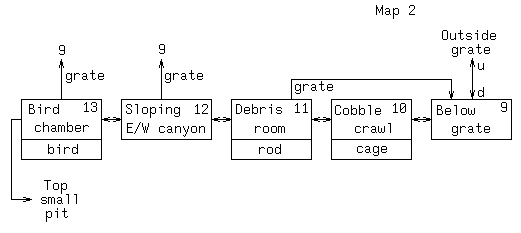
- 13 YOU ARE IN A SPLENDID CHAMBER THIRTY FEET HIGH. THE WALLS
- 13 ARE FROZEN RIVERS OF ORANGE STONE. AN AWKWARD CANYON AND A
- 13 GOOD PASSAGE EXIT FROM EAST AND WEST SIDES OF THE
CHAMBER.
Illustration: Excerpt from the data file for Will Crowther's original
cave-exploration game. These lines represent locations the player encounters
near the Bedquilt entrance of Colossal Cave.
Example 4 shows these descriptions at work in Giloogly's 1977
port of the Crowther/Woods source code.
Example 5.
Crowther -- Bedquilt Entrance to Colossal Cave
Don Woods added rich layers of complexity and polish that turned Crowther's code
from a brilliant idea into a finished game, but Crowther's humor, fantasy,
combat and puzzles had already set a tone that would define the genre. In
addition to the “Magic Word XYZZY” (see
Example 5), players of Crowther's original game
encountered belligerent dwarves, a surprisingly resourceful bird, a rusty metal
rod with magical powers, and help text that announces “MAGIC
IS SAID TO WORK IN THE CAVES.” Since Woods never visited Colossal
Cave, the new rooms and scenic elements he created (such as the underground
volcano and the battery-dispensing vending machine) obviously reflect his own
imagination, rather than the real subterranean landscape.
Photographic Walkthrough
Like the benevolent omniscient narrator of Victorian fiction, the narrator of
“Adventure” — the “I” who answers
the player's request for help — chooses to divulge certain details and withhold
others. This characteristic of the game reflects the values of an experienced
caver, who is typically reluctant to tell outsiders exactly where the entrances
are: “They'll take a flashlight and a clothesline and one or
the other will break or malfunction and then they'll die or have to be
rescued, and you'll be responsible”
[
Cahill 2001]. For good reason, then, CRF members and National
Park Service employees are reluctant to publicize the location of any
undeveloped cave entrance.
The Bedquilt Rinky-Dink (Building and Forest)
Using a publicly-available map, the following details of the region were
determined in 2004 by Mann:
The (closed) road from the
Collins House and the Austin house (now torn down) runs south about one
mile to a public road. The Pumphouse was at the end of another closed
road (not shown on my map) on the other side of that public road about
one-half mile southwest at the Adwell Spring. The Bedquilt entrance is
about another one-half mile southwest, downstream. The Colossal entrance
is about one-half mile westnorthwest of the Bedquilt entrance, over the
ridge. [Mann 2004]
Via MapQuest's “Place Name” feature, Adwell Spring
is easily located as a site within Mammoth Cave National Park.
Of the small brick building (which Crowther [
Crowther 1976]
describes as “A WELL HOUSE FOR A LARGE SPRING”)
built by the U.S. Park Service to house a pump that supplied water for
visitors, only the foundation remains. While the Cave Research Foundation
did not store supplies there, the “Adventure”
player finds a bottle, a shiny brass lamp, tasty food, and keys inside.
According to the
Cave Research Foundation Personnel
Manual
[
Freeman 1975], the U.S. Park Service usually locks entrances
to caves in Mammoth Cave National Park, and keys are issued to each small
party of cavers [
Freeman 1975, 33]. The other items found
in the building also hold a special significance within caving culture.
In the chapter entitled “Caving
Equipment,” the handbook [Cave Research
Foundation Personnel Manual] lists, among other items,
“Food” (because cavers typically eat one
or two meals on an expedition), a “Container for
lamp water,” and “Metal carbide
lamp.” Carbide is a substance that reacts with water to produce a
flammable gas. Crowther supplied the game with a lamp, a bottle, and a
source of water — but no carbide. Cave Research Foundation member Tom
Brucker, who worked with the Crowthers on their intensive 1974 survey of
Bedquilt, recalls that when he first played the game, he assumed the
brass lantern would run out of carbide fuel, and assumed that winning
the game would require finding a fresh supply….(It was Woods who
supplied the “Adventure” lamp with a timer
that warns the player that the lantern's power is running out, and who
also added an underground vending machine — the source of fresh
batteries.) Other items that are not implemented as objects in the game,
but whose presence is implied, include a pack and a compass. The CRF
manual offers a thoughtful soliloquy on the ideal proportions and strap
configuration for a cave pack (26), and a whole chapter explains the
proper use of a compass during a map-making survey.
[Jerz and Thomas 2005]
Obviously enough, cavers use a bottle as a source of drinking water. Less
obvious: cavers also use a bottle to carry their own waste water out of the
cave.
Difficulty in finding the cave entrance is often a significant part of a real
visit to the Bedquilt region of Colossal Cave. According to a CRF trip
report dated 30 Jun 1974, leader Richard Zopf and party members Pat and Will
Crowther
had trouble following the road in and cut down the
valley early to find the entrance which was cleverly hidden by mud.
Pat and Will scratched their heads and the sand alternately, and
soon our shovel scratched the gate, about 1.5 feet down. It is, as
one faces the hill, directly opposite the higher hole and next to
the left bank. We cleaned the gate and got the old lock to open. The
lock should be replaced with a Park service lock next trip. The new
lock should be well-oiled. We relocked the gate, ascended the hill,
and followed the road all the way back. The ticks were minimal.
[Brucker, L. 2005]
In the game, the player can reach the entrance simply by going south from the
pumphouse. But among cavers, an unsuccessful excursion to the Bedquilt
entrance is a common experience known as “The Bedquilt
Rinky-Dink.”
Bedquilt Entrance
The old horizontal gate and the concrete structure in which it was set were
removed in 1994, according to the National Speleological Society. “Friday the entire Field Camp crew went to the Bedquilt
Entrance to remove the debris from that project. This consisted of the
old gate, a steel monster that took four people to haul up the hill, the
broken concrete from the former gate base and the tools used on the
project. We formed a chain gang part of the way up the hill and passed
the broken concrete from person to person…. The debris was loaded into a
waiting trailer and removed from the area. ”
Cobble Crawl to Debris Room
In a telephone interview, Crowther's sister Betty Bloom, who was one of the
original play-testers of “Adventure”, shared an
anecdote: “I was bored having to go through all the steps
every time, and I said, ‘I want to go directly into the game.’
[
Dramatic pause.]
‘Ecks-why-zee-zee-why!’
”
[
Bloom 2002]. Crowther confirmed this detail about the word, which teleports the
player to and from the small building: “Betty was
correct that I created it for her - she is an impatient sort, and wanted
a shortcut. I figured why not, there are lots of impatient people out
there who would appreciate a shortcut”
[
Bloom 2002]. According to Bloom, “XYZZY” was a family password. “If the kids ever
got lost in an airport, and they ever had to verify who they were, we
would just ask them for a magic word, and it would be XYZZY.”
While Crowther states that “XYZZY was not a family
password - I made it up out of whole cloth just for the game,” we
may imagine that
other family members used it as a password,
after Crowther invented it for the game. In telephone
interviews, Bloom and Crowther's daughters all spelled out the letters in
the word, but they report that Crowther himself pronounced it
“zizzy.” According to Crowther
(2007), “Magic words should look queer, and
yet somehow be pronounceable - XYZZY seemed pretty good that way. I was
considering working for XEROX at the time, which probably suggested
starting with an X.” [
Crowther 2007] Asked about Hunsinger's observation that
XYZZY is “a mnemonic device to remember how to do cross
products”
[
Adams 2007b], Crowther replied, “I've
never heard that math mnemonic.”
Bird Chamber to Hall of Mists
While Woods retained the name “Bird Chamber,” many
later versions of “Adventure” present this room
as “Orange River Chamber.” No birds are likely to
be found singing this deep in the cave, but the cave formations here do
resemble a certain prop associated with the bird.
A Maze of Twisty Little Passages, All Alike
You're At Y2... A Hollow Voice Says “PLUGH”
Another of the commonly-repeated memes about Colossal Cave describes Y2 as
“a common notation on maps denoting a secondary
entrance”
[
Adams 2007a]. CRF members say that it is merely a label given
to a survey station, the second in a series of points along a survey route
that happened to use the letter Y. A CRF trip report dated November 1974
indicates that Crowther led a team that began the Y survey in the Bedquilt
area of Colossal Cave [
Brucker, L. 2005]. While there are other
entrances to Colossal Cave, there is no such entrance near “YOU'RE IN Y2.” While Y2 is the only survey code
mentioned in the game, in the real cave, similar alphanumerical marks are
often spotted (see
Figure 25, on one of the
slabs occupying the space where Crowther put the crystal bridge).
At Window on Pit
The party's computer game specialist must have seemed reasonably competent
during his first attempt at applied caving. After bringing the party to the
Y2 junction, leader Dave West pointed to a tiny opening five feet off the
ground — about a foot high and two feet wide — and said, “Go that way.”
It is one thing to squirm through a tight passage when one can always see
several people ahead, silhouetted against the lighted walls. It is a much
more stressful experience to plunge ahead towards the darkness that lurks,
grue-like, beyond the flickering edges of sight. The roof of the narrow
passage opened up before long, and then the bottom dropped away. The
destination turned out to be what Crowther called Room 35, “Window on Pit” (see
Figure
38), “WHICH GOES UP AND DOWN OUT OF
SIGHT.” (Figures
39,
40). Woods created a second room (#110) with
the same name, and also created a shadowy figure who waves back at you from
a lighted window on the other side of the pit. While the bottom of the pit
is only implied in Crowther's game, Woods implemented it as follows:
SUSPENDED FROM SOME UNSEEN POINT FAR ABOVE YOU, AN ENORMOUS
TWO-SIDED MIRROR IS HANGING PARALLEL TO AND MIDWAY BETWEEN THE CANYON
WALLS. (THE MIRROR IS OBVIOUSLY PROVIDED FOR THE USE OF THE DWARVES, WHO
AS YOU KNOW, ARE EXTREMELY VAIN.) A SMALL WINDOW CAN BE SEEN IN EITHER
WALL, SOME FIFTY FEET UP.
(Woods's Room 109, “YOU'RE
IN MIRROR CANYON.”) This riff on Crowther's original
geography, and the off-beat approach to the setting, is a typical example of
Woods's tendency to introduce a comic tension within the spirit of
Crowther's original.
At Brink of Climbable Pit
Cavers have a wry sense of humor and an easy communal nature. While mountain
climbers who pause to rest before making the return trip can focus on the
view, the CRF members faced each other and swapped stories at “AT BRINK OF CLIMBABLE PIT.” When it was time to go,
West turned to the newest member of the party — a caving theorist who often
has trouble finding his car in the faculty parking lot — and said, “You're
going to lead us out.”
Cavers Reflect on “Adventure”
Crowther's ex-wife Patricia Wilcox did not play or even know about the original
version of the game. She recalls a CRF meeting in “1976 or
77” in which many members who had ostensibly come to Boston for a
weekend of mapping instead spent hours playing the Crowther/Woods “Adventure.” She described the geography of the game as
“Completely different from the real cave. It used names
that we made up,” though her assessment is likely influenced by the
sections added by Woods. According to
Crowther
(2001), “the geometry [of the game] was lifted
directly from Bedquilt Cave.”
Other cavers have reported that the geography of the game closely matches the
geography of the cave. For example,
Park (1994)
reports that an “Adventure” fan and novice caver, Bev
Schwartz, knew the game so well that, on her first trip into the real cave,
“We would be at a junction and she would ask compass
directions and then begin to tell us what was down this passage or the other
– all correctly!” Park also offers an anecdote of a party's encounter
with a real snake while climbing up into the Bird Chamber (see Figures
21,
22,
23): “[O]ne party member, Roger,
noticed to his horror a copperhead snake (was it THE SNAKE?) on the ledge
next to his right hand…. Confronted by the snake, Roger was so beside
himself that all he could do was yell ‘Strike, strike’ as the
copperhead proceeded to do just that. Tom, the party leader, had already
made the climb up (and not seen the snake). Looking around for something to
do, he found a stick (was it the MAGIC WAND?), in the Bird Chamber (the room
with the rivers of orange stone, actually a beautiful column of orange
travertine). Wand in hand, he moved the snake away.”
Park's references to a snake and rod illustrate the general opinion among cavers
that Crowther's cave and game are very closely connected. Nevertheless, Crowther
did make certain deliberate changes when he created the game. For instance, he
invented the fissure that blocks the player's progress at the Hall of Mists. Tom
Brucker, who caved with the Crowthers while they were mapping the site, reports
that in order to create the crystal bridge puzzle,
[21] Crowther edited out a
passage that would have enabled an easy bypass.
Will never liked that passage, even though it loops back to
the Hall of the Mountain King.….Will based the game on what we purposely
called “The Bad map of Bedquilt” … a very quick,
[albeit] elegant, map that challenged us during the Bedquilt project to fill
in the missing parts. There were plenty of parts missing.
[Brucker, T. 2005a]
When asked what elements of Crowther's personality he finds in the game, Brucker
stated that Crowther is the sort of person who would say, “You want to see how clever I am? I took your 300 lines
of code, and I reduced it by 47%. He didn’t set out to
be
clever. [He would say] Let’s set out to make some puzzle and see if
someone can solve it. It really reflects his nature…. I think he’s that
little dwarf, throwing the axe at you. He won’t leave you alone. Whoosh!
Come on. Figure it out!”
[
Brucker, T. 2005a]
Adjusting the Adventure Timeline
Numerous timelines of computer and gaming history and multiple sources report that
Crowther's original game was abandoned as early as 1972, and that Woods released his
updated version in 1976. Both dates are incorrect.
The false date of 1972 has attracted many compilers of timelines and internet
histories, possibly because it is the date the former Patricia Crowther traversed a
tight passage between two networks of caves previously thought to have been
unconnected — an event that marks the climax of Brucker and Watson's
The Longest Cave (1976). Interviews with Crowther and his
family members (sister, two children, and ex-wife) all confirm that the game was
created shortly after the divorce, which they all say happened in mid-1975 [
Crowther 2001]; [
Bloom 2002]; [
Carter 2002]; [
Lawrence 2002]; [
Wilcox 2002]. Betty Bloom,
Crowther's sister, recalls spending her sabbatical with Crowther during the time he
created the game, and was a regular playtester. According to Bloom's records, that
sabbatical took place during the academic year of 75-76. In separate telephone
interviews, Crowther's children Sandy (born in 1967) and Laura (born in 1970) recall
being eight and “less than six,” respectively, when they
first played the game, during a school vacation when they were staying with their
father.
Crowther (2001) recalls creating “Adventure” over a period of several weekends; likewise, his
daughters recall watching the game develop across a span of several different school
vacations. None of the family members remembers which school vacations were
involved. Bloom and Sandy both indicate Laura had already turned six, which would
place the creation of “Adventure” after Laura's sixth
birthday (in January of 1976). According to Laura: “I think 1972
is early -- I would have been two.”
When asked what her father thought of Woods's expansion, Laura (who became a
middle-school science teacher) said, “I remember being extremely
irritated by things like the pirate, and Dad saying not to blame
him, it wasn't his fault!” Sandy (who became a Sun Solaris
administrator) has vivid memories of being “addicted” to
playing the Crowther/Woods version when she was older; as a child, she remembers
mostly being frustrated by her father’s version. When asked about her father's
reaction to Woods's expansions, she recalled: “I got stuck with,
‘Kill dragon.’
‘What with, your bare hands?’ You have to say, ‘yes.’ I remember my father saying, ‘That was Don Woods.’
”
All Crowther family testimony is consistent with the 1975-76 date range. Responding
to a direct request via e-mail,
Crowther (2001)
dated his original “Adventure” to 1975, “give or take a year.” Certainly Crowther had stopped
working on the game by the time Woods contacted him (by sending an e-mail to “crowther” at every domain name in existence at the time).
Woods, in early interviews, gave March or April of 1976 as the date he released his
expansion; but after examining backup files from his Stanford student account, he
now says
(2007) his estimate was off by a year,
because the oldest relevant files in Woods’s student account (likely representing
when Woods started on the code, not when Crowther stopped) bear the date March 11,
1977. Gilbert (one of Woods's Stanford classmates) had written “I'm pretty certain it was between October and December 1975
when Don and I first ran across it”
[
Gilbert 2005], which supports Laura’s memory of being “less than
six” and thus makes a plausible case for 1975; nevertheless, when informed
that Woods now uses the 1977 figure, Gilbert also suggested that 1975 may be “off by a year”
[
Gilbert 2007]. The most likely timeline places Crowther ceasing work on his original game
in early 1976.
This new timeline results in an even faster trajectory for key events in the advance
of the new genre. Crowther's memory [
Hafner 1994] of “Adventure” having gained a following a month after he put
the program on his BBN account and left for a vacation is supported by the fact that
one of these early fans brought it to a Stanford computer, where Woods encountered
it. Some time before March 11, 1977, Woods contacted Crowther, who gave him access
to the source code. By March 23, we see in Woods’s records a version with some 20
additional lines of code — a low-level subroutine that Woods supplied in order to
get the source to compile. The March 31 set of files again show only minor tweaks.
The evidence demonstrates Woods was working on Crowther's source code during March,
but during that month we see no evidence of Woods's creative expansions.
Woods must have been very busy during April. By mid-May, hackers at MIT had noticed
the game. After they solved it, “the true lunatics began to think about how they could do it
better”
[
Anderson 1985], and by June, “Zork” had already taken
recognizable form. When one considers that this pioneering work on text adventure
games was happening during a time span which includes the May 25 release of
Star Wars and the June 5 sale of the first Apple
computers, it is not likely that any other similar time span has encompassed so many
seminal events in geek culture.
Conclusions
The research expedition to the real Colossal Cave in Mammoth Cave National Park
confirms that the map of Will Crowther's original “Adventure” closely follows the geography of the real cave, but with fantasy
and puzzle elements. The original source code shows that Crowther selectively
deviated from realism; the tension between the altered geography and the mostly
naturalistic text illustrates Crowther’s respectful intimacy with the natural
wonders of Colossal Cave. Woods added complexity and polish, with a careful eye for
improving the user’s experience (and, occasionally, proofreading). His contributions
more than doubled the size of the original data file (from 728 lines to 1809) and
more than quadrupled the size of the code file (from 709 lines to 2949). When
expanding the geography, Woods improvised freely, yet his additions form an
agreeable tension with Crowther’s naturalistic setting.
Relevant details from caving culture which offer insights into “Adventure” include artifacts in the real “Colossal
Cave,” such as an axe head and a rusty iron rod; human alterations to the
natural cave, such as carved stone steps and a locked iron gate; natural geographic
features, such as the striking formations of orange rock and the huge stone slabs
occupying the space where a magical bridge appears in the game; and newly-assembled
evidence of Crowther's activities in Colossal Cave, including Cave Research
Foundation maps and trip reports. This evidence demonstrates the extent to which
Crowther's familiarity with the real cave provided inspiration for a genre-defining
new form of artistic expression.
Acknowledgements
This article was made possible in its present form by a travel grant from Seton Hill
University; as well as the cooperation of the Cave Research Foundation (most notably
the Brucker family); the professionalism of the Digital Humanities Quarterly
editorial staff; the willingness of many, many correspondents who scrounged through
their filing cabinets, attics, and memories for forgotten treasures; and the bemused
consent of my wife. Particular thanks are due to the cooperation of Will Crowther,
his family and associates; and to Don Woods, who offered gracious notes on an
advanced draft. Mistakes or omissions are my own. — DGJ
Works Cited
Aarseth 1997
Aarseth, Espen J.
Cybertext: Perspectives on Ergodic Literature.
Baltimore: Johns Hopkins UP,
1997
Anderson and Holmqvist 1990
Anderson, Peter Bogh and Holmqvist, Berit
“Interactive Fiction: Artificial Intelligence as a Mode of Sign
Production”, AI and Society, 4:
291-313.
Bennahum 1998
Bennahum, D.
Extra Life: The Coming of Age in Cyberspace. New
York: Basic Books, 1998.
Bloom 2002
Bloom, B. Telephone interview, 01 July 2002.
Briceno et al. 2000
Briceno, H., Chao, W., Glenn, A.,
Hu, S., Krishnamurthy, A., and Tsuchida,
B.
“Down from the Top of Its Game: The Story of Infocom, Inc.”
[undergraduate class project, “6.933J/STS.420J: The Structure of
Engineering Revolutions”], MIT, December 2000.
http://web.mit.edu/6.933/www/Fall2000/infocom/infocom-paper.pdf.
Brucker and Watson 1976
Brucker, Roger W. and Richard A. Watson. The Longest Cave. Carbondale:
Southern Illinois UP, 1976.
Brucker, L. 2005
Brucker, L.
“Work in Colossal with Will Crowther's time (1974 - 1975)”.
Excerpts from Cave Research Foundation trip report database. E-mail to the author,
03 Apr 2005.
Brucker, T. 2005a
Brucker, T. E-mail to the author 04 Apr 2005.
Brucker, T. 2005b
Brucker, T. Personal interview, CRF Hamilton Valley Facility, Kentucky,
08 July, 2005.
Buckles 1985
Buckles, M. A.
“Interactive Fiction: The Computer Storygame ‘Adventure’
”. Ph.D. Thesis. U. Cal at San Diego,
1985.
Cahill 2001
Cahill, T.
“A Rudiment for Cavers.” In Taylor, R.,
Caves: Exploring Hidden Realms. Washington,
D.C.: National Geographic, 2001:
187.
Carter 2002
Carter, L. Telephone interview, 01 July 2002.
Chaplin 2007
Chaplin, H.
“Is That Just Some Game? No, It’s a Cultural Artifact”,
New York Times, 21 Mar 2007.
Costikyan 2007
Costikyan, G.
“Games, Storytelling and Breaking the String.” In Harrington,
P. and Wardruip-Fruin, N. (eds.), Second Person: Role-Playing and
Story in Games and Playable Media. Cambridge:
MIT Press, 2007, 5-13.
Crowther 2001
Crowther, W. E-mail to the author, 15 Jun 2001.
Crowther 2007
Crowther, W. E-mail to the author, 26 March 2007.
Crowther and Crowther 1975
Crowther, W. and Crowther, P. “Flint Mammoth Cave System: Bedquilt Section, Colossal Cave.” Survey map.
Cave Research Foundation, 1975.
Douglass 2007
Douglass, J.
“Enlightening Interactive Fiction: Andrew Plotkin's Shade.”
In Harrington, P. and Wardruip-Fruin, N. (eds.), Second Person:
Role-Playing and Story in Games and Playable Media.
Cambridge: MIT Press, 2007,
129-136.
Freeman 1975
Freeman, J.
CRF Personnel Manual: Central Kentucky Karst Area, 2nd
edition. Columbus, Ohio: Cave Research
Foundation, 1975.
Gilbert 2005
Gilbert, J. E-mail to the author, 13 Apr 2005.
Gilbert 2007
Gilbert, J. E-mail to the author, 08 Jun 2007.
Hafner and Lyon 1996
Hafner, K. and Lyon, M.
When Wizards Stay Up Late: the Origins of the Internet.
New York: Simon and Schuster,
1996.
Harrington and Wardruip-Fruin 2007 Harrington, P.
and Wardruip-Fruin, N. (eds.), Second Person: Role-Playing and
Story in Games and Playable Media. Cambridge:
MIT Press, 2007.
Herz 1997
Herz, J. C.
Joystick Nation: How Computer Games Ate Our Quarters, Won Our
Hearts and Rewired Our Minds. Boston:
Little, Brown, 1997.
Howell and Douglas 1990
Howell, G. and Douglas, J. Y.
“The Evolution of Interactive Fiction”, Computer Assisted Learning: An International Journal, 2:
93-109.
Hutcheon 1988
Hutcheon, L.
A Poetics of Postmodernism. New York and
London: Routledge, 1988.
Jerz and Thomas 2005
Jerz, D. and Thomas, D. “Cave Gave
Game: The Subterranean as Game”. 2005. Unpublished.
Juul 2005
Juul, J.
Half-Real: Video Games between Real Rules and Fictional Worlds.
Cambridge: MIT Press, 2005.
Keller 2007
Keller, D.
“Gaming, Identity and Literacy.” In Selfe, C. and Hawisher,
G. (eds.). Gaming Lives in the Twenty-first Century.
New York: Palgrave Macmillan,
2007, 71-87.
Kidder 1981
Kidder, T.
The Soul of a New Machine. Boston:
Little Brown, 1981.
Kraley 2004
Kraley, M. E-mail to the author, 27 Feb 2004.
Lawrence 2002
Lawrence, S. Telephone interview, 01 July 2002.
Levy 1984
Levy, S.
Hackers: Heroes of the Computer Revolution.
New York: Anchor Press, 1984.
Mann 2003
Mann, W. E-mail to the author, 30 Jul 2003.
Mann 2004
Mann, W. E-mail to the author, 27 Feb 2004.
McGonigal 2008
McGonigal, J.
“Why I Love Bees: A Case Study in Collective Intelligence
Gaming”, preprint of article forthcoming in Salen, K. (ed), Ecologies of Play.
Montfort 2003
Montfort, Nick. Twisty Little Passages.
Cambridge: MIT Press, 2003.
Murray 1997
Murray, J.
Hamlet on the Holodeck: The Future of Narrative in
Cyberspace. New York: Free Press,
1997.
Nelson 2001
Nelson, G.
Inform Designer's Manual, 4th ed. St. Charles,
Illinois: The Interactive Fiction Library,
2001.
Poole 2000
Poole, S.
Trigger Happy. New York:
Arcade Publishing, 2000.
Raymond 1996 Raymond, E. (ed). The New Hacker's Dictionary, 3rd ed. Cambridge:
MIT Press, 1996.
Rothstein 2002
Rothstein, E.
“Realism May Be Taking the Fun Out of Games”, New York Times, 06 Apr 2002.
Selfe and Hawisher 2007 Selfe, G. and Hawisher (eds.).
Gaming Lives in the Twenty-first Century. New
York: Palgrave Macmillan, 2007.
Turkle 1995
Turkle, S.
Life on the Screen: Identity in the Age of the Internet.
New York: Simon and Schuster,
1995.
Van Vleck 2001
Van Vleck, T. E-mail to the author, 01 Feb 2001.
Wilcox 1990
Wilcox, P. Re: XYZZY. alt.folklore.computers posting, 06 Feb
1990.
Wilcox 2002
Wilcox, P. Telephone interview, 24 May 2002.
Woods 2007
Woods, D. E-mail to the author, 11 Mar 2007.